.png)

Most Salesforce orgs already use some form of automation. Chatbots answer FAQs, route cases, and reduce ticket volume. That worked when the goal was deflected. Today, the pressure is different. Teams want work to move faster, with fewer handoffs and less manual effort.
This is where AI agents enter the picture. Chatbots help people get answers. AI agents help systems get work done. They can reason over data, trigger workflows, and act across Salesforce and connected platforms.
This blog talks about the real difference between the two, why it matters now, and how to choose the right model without overcomplicating your Salesforce architecture.
Salesforce moved from basic chat automation to autonomous AI agents as business needs and technology evolved. Each stage added new capabilities that expanded what automation could handle across the CRM and connected systems.
In September 2016, Salesforce introduced Salesforce Einstein, embedding predictive intelligence across Sales Cloud, Service Cloud, and other CRM applications. Einstein enabled scoring, forecasting, and recommendations directly within CRM records and workflows.
This phase was foundational. It did not introduce conversational automation, but it established something critical: Salesforce could interpret data patterns, understand business context, and apply intelligence at scale. Without this layer, later conversational and agentic systems would not have been possible.
Between 2017 and 2018, Salesforce expanded Einstein into conversational interfaces. In July 2018, Einstein Bots for Service became generally available, allowing organizations to automate routine service interactions such as FAQs, case intake, and basic triage.
These bots were intentionally deterministic. They relied on predefined flows, scripted paths, and admin-configured logic. While effective at reducing service load and improving response times, their role was limited to guiding conversations and collecting inputs. They could trigger workflows, but they did not own them.
By 2023, Salesforce began preparing the platform for a deeper shift. Conversational interfaces became more context-aware, capable of summarizing interactions, referencing CRM data, and assisting users across screens and channels.
This period mattered less for individual features and more for what it enabled: conversational systems could now operate with broader context, making them suitable for multi-step interactions rather than single-turn responses. This set the stage for agents that could move beyond assistance into execution.
In February 2024, Salesforce announced Einstein Copilot, a conversational layer embedded across Service Cloud and other Salesforce applications. Copilot unified conversational access to data, flows, and actions through a single interface.
The copilot marked a clear transition point. Conversations were no longer isolated. Users could initiate tasks, retrieve context, and progress work without switching tools. While still guided and assistive, Copilot demonstrated how conversational interfaces could orchestrate actions, not just respond.
On July 17, 2024, Salesforce introduced Einstein Service Agent, the first Salesforce-native AI agent designed to operate without predefined dialogue paths. Unlike chatbots, this agent could reason over context, decide next steps, invoke workflows, and escalate only when required.
This release represented a structural shift. Automation was no longer front-loaded in conversation design. Agents persisted across steps, tracked state, handled exceptions, and owned outcomes within defined guardrails. Service automation moved from scripted assistance to autonomous execution.
In September 2024, Salesforce launched Agentforce, formalizing agentic AI as a platform capability rather than a product feature. Agentforce enabled organizations to design, deploy, and govern AI agents across service, sales, and operational use cases, decoupled from chat UI alone.
With Agentforce 2.0 in December 2024, Salesforce expanded agent reasoning depth, workflow orchestration, and enterprise governance. Agents could now operate across objects, systems, and processes with clearer controls, auditability, and scalability.
By 2025 and into 2026, Salesforce’s AI roadmap centers on Agentforce 360, an agentic layer that spans CRM, Data Cloud, integrations, and enterprise workflows. The focus shifts from individual agents to coordinated systems of agents operating with shared context, permissions, and objectives.
At this stage, conversational AI is no longer treated as a feature. It becomes an execution interface for CRM-native digital labor. Conversations trigger action, agents own processes, and Salesforce positions itself as an agent-first enterprise platform.
This comparison is often framed as a capability upgrade. In reality, it is a shift in responsibility. Traditional chatbots and AI agents are built for different roles inside Salesforce, and treating them as interchangeable usually leads to broken workflows, unclear ownership, and automation that looks impressive but delivers little operational value.
Below are 10 differences that actually matter in real Salesforce implementations:
Traditional chatbots exist to assist conversations. Their primary role is to reduce friction at the entry point, answering common questions, guiding users through predefined paths, or collecting information before routing a request further. Once the conversation reaches complexity, the chatbot’s job is essentially done.
AI agents exist to complete work. They are designed to take responsibility beyond the conversation, ensuring that a task progresses toward completion. In Salesforce terms, this means owning actions across objects, workflows, approvals, and integrations rather than simply handing them off.
The difference is subtle in UI, but fundamental in architecture. One supports interaction. The other owns execution.
Traditional chatbots operate in short, session-bound interactions. They assume that each conversation is a self-contained event. Context is often limited to what is captured during that session, and once the interaction ends, continuity is lost.
AI agents operate across long-running interactions. They persist beyond a single conversation, track progress across steps, and resume work as new information becomes available. This is critical for Salesforce processes that span hours, days, or even weeks, such as service resolution, onboarding, or fulfillment workflows.
Traditional chatbots rely on predefined logic. Admins or developers map out intents, decision trees, and flow paths in advance. Every valid outcome must be anticipated and designed upfront.
AI agents reason within boundaries. Instead of following a single scripted path, agents evaluate the current context, determine the appropriate next step, and execute it. Guardrails still exist, but execution is adaptive rather than rigid.
Traditional chatbots work with shallow context. They may reference a case number, order status, or knowledge article, but context is usually limited to a single object or session. Cross-object awareness is minimal.
AI agents operate in a persistent, governed context. They use CRM data, Data Cloud profiles, workflow state, and integration responses together. This allows agents to understand not just what the user asked, but where the process currently stands.
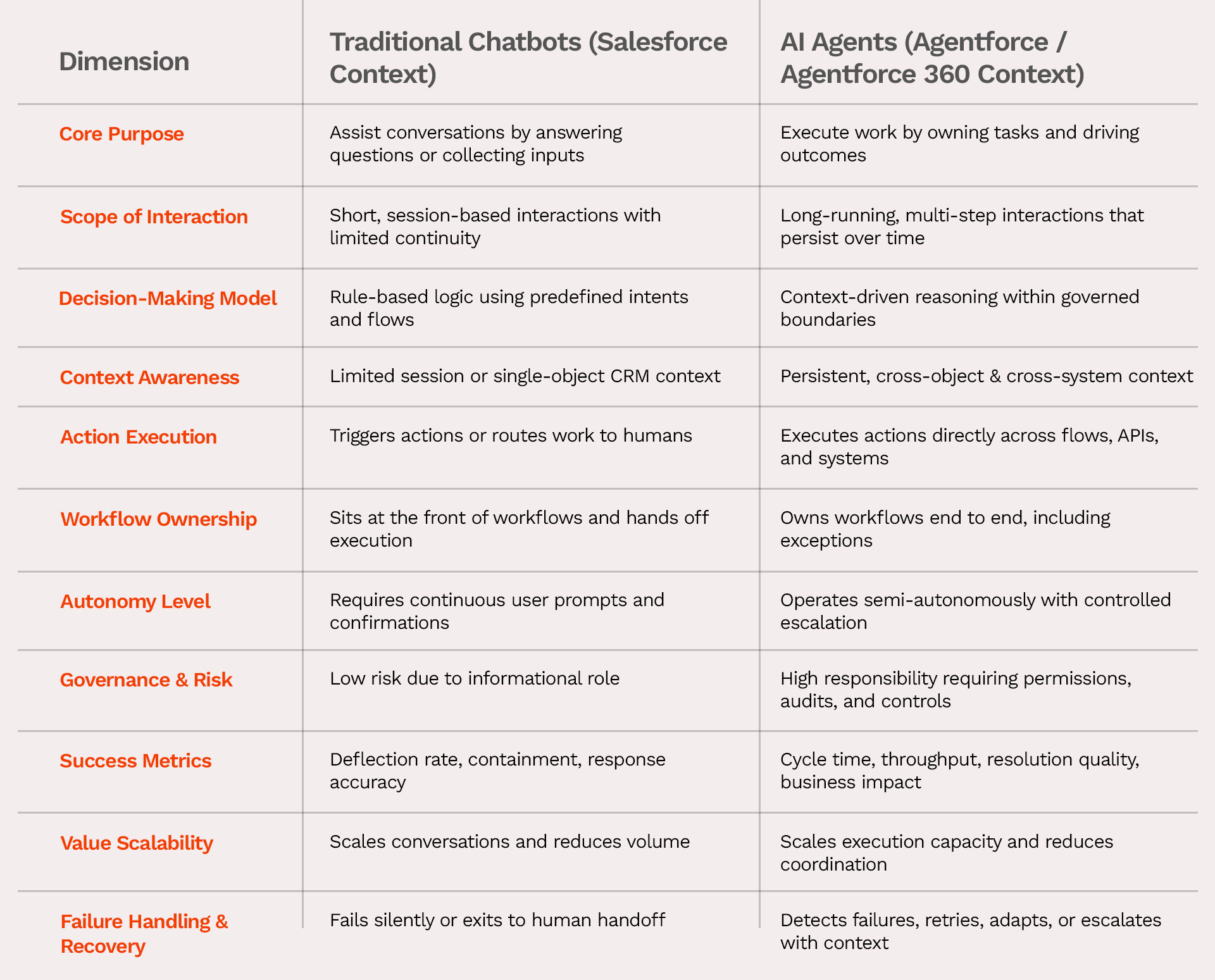
Traditional chatbots initiate actions. They might trigger a flow, create a case, or route a task, but execution responsibility moves elsewhere immediately.
AI agents execute actions directly. They invoke flows, call APIs, update records, and monitor outcomes. Execution does not stop at initiation; the agent remains responsible until the task is completed or escalated.
Traditional chatbots sit at the front of workflows. Once information is collected, ownership passes to humans or backend automation. The chatbot is no longer involved.
AI agents own workflows end to end. They manage branching logic, handle exceptions, wait for dependencies, and close loops. The workflow does not fragment across systems because ownership remains centralized.
Traditional chatbots depend on constant user interaction. They ask follow-up questions, request confirmations, and rely on humans to keep the process moving.
AI agents operate with controlled autonomy. They act independently within defined guardrails and escalate only when thresholds are crossed. Human involvement becomes intentional rather than reactive.
Traditional chatbots carry limited operational risk. They inform and assist, but rarely perform irreversible actions.
AI agents introduce real operational responsibility. Because they execute work, they require strict permission models, approval logic, audit trails, and policy enforcement. Governance is not optional; it is foundational.
Traditional chatbots are measured by conversational metrics.Deflection rates, containment, response accuracy, and CSAT dominate reporting.
AI agents are measured by execution outcomes. Cycle time reduction, throughput improvement, resolution quality, and operational efficiency define success. The focus shifts from interaction quality to business impact. Metrics reflect responsibility.
Traditional chatbots scale conversations. They reduce volume but do not fundamentally change how work flows through the system.
AI agents scale execution capacity. They reduce handoffs, compress timelines, and allow Salesforce orgs to handle more work without proportional increases in human effort.
Traditional chatbots fail silently or exit early. When a workflow breaks, data is missing, or an integration call fails, the chatbot typically ends the conversation, reroutes to a human, or restarts the interaction. Error handling is shallow and often invisible, pushing recovery work downstream to service teams or admins.
AI agents are designed to detect, manage, and recover from failure. They recognize when an action cannot be completed, attempt alternative paths where permitted, wait for dependencies, or escalate with full context. Recovery is treated as part of execution, not as an exception outside the system.
This difference matters because real-world Salesforce workflows fail often, and systems that cannot recover create more work than they remove.
This decision is not about ambition. It is about fit. The right choice depends on the type of work you want to automate, how much responsibility the system needs to handle, and how mature your Salesforce setup is today. The sections below show how experienced teams make this decision in real projects.
The first question is not technical; it is functional. If the primary requirement is answering questions, guiding users, or collecting structured inputs, traditional chatbots remain effective. They are well-suited for predictable interactions where the value ends once information is exchanged or a request is routed.
AI agents become relevant when the work does not end at the conversation. If the request requires multiple steps, validations, updates across objects, or coordination with other systems, an agent-based approach is more appropriate. The key signal is ownership: if the system must stay accountable until completion, a chatbot will fall short.
Single-system workflows favor chatbots. When automation stays within one Salesforce cloud, uses limited data, and relies on straightforward flows, chatbots are easier to design, deploy, and govern.
As soon as workflows span CRM objects, Data Cloud, integrations, or external platforms, complexity increases sharply. AI agents are designed for this environment. They coordinate actions across systems, manage dependencies, and maintain state without restarting the interaction at every boundary.
Chatbots can operate with partial or surface-level data. Knowledge articles, case categories, and simple CRM lookups are often sufficient.
AI agents require reliable, structured, and governed context. They depend on accurate CRM data, consistent object models, and, increasingly, unified profiles from Data Cloud. If your data is fragmented or poorly governed, agents will amplify those issues rather than solve them. Data readiness is a prerequisite, not an afterthought.
Chatbots introduce minimal operational risk because they inform rather than act. Governance is largely limited to content accuracy and routing logic.
AI agents perform real work. They update records, trigger workflows, and interact with external systems. This requires clear permission models, approval mechanisms, audit trails, and policy enforcement. Organizations that are not prepared to govern automation at this level should delay agent deployment until controls are in place.
Chatbots are human-dependent by design. They rely on users or agents to move processes forward once information is gathered.
AI agents change the human role. Humans shift from executors to supervisors. They step in for approvals, exceptions, or high-risk decisions rather than routine coordination. This model works best when escalation paths are clearly defined and trusted.
Chatbots are cheaper to build and easier to maintain. They rely on flows, scripts, and limited monitoring.
AI agents require higher upfront investment. Designing execution logic, monitoring behavior, handling failures, and maintaining governance adds complexity. However, long-term value increases as agents reduce operational effort rather than just conversation volume.
If success is measured in deflection, faster responses, or reduced ticket volume, chatbots align well with those goals.
If success is measured in cycle time reduction, throughput improvement, or consistent execution at scale, AI agents are the better fit. Misalignment here is one of the most common causes of automation disappointment.
The right choice is rarely chatbot or agent, it is chatbot where conversation ends and agent where execution begins. Teams that make this distinction early build automation that scales with their Salesforce org instead of fighting it.
If you’re evaluating how far automation should go in your Salesforce org, start with clarity, not features. Whether you’re refining existing chatbots or exploring Agentforce-driven execution, the right approach depends on architecture, data readiness, and governance.
As a trusted Agentforce Consulting partner, we help businesses assess where conversational automation should stop and where agentic execution should begin, so automation delivers outcomes, not overhead.
If your automation still hands work back to humans, it’s not finished.
See how we help teams design AI agents that own execution, handle exceptions, and scale without chaos.

5+ years of experience across content, social media, and growth marketing. At MIDCAI, I focus on turning complex ideas around AI, data, and technology into clear insights and campaigns that help businesses attract and engage the right audience.
Get in touch with us for any enquiries and questions
Define your goals and identify areas where technology can add value to your business
We are looking for passionate people to join us on our mission.
where your skills fuel innovation and your growth powers ours