

Have you ever been part of a team where everything looked perfect on paper? The strategy was solid. The goals were clear. The technology was in place. Yet, deadlines slipped, collaboration broke down, and execution never quite matched the vision.
Now think about another team that didn't have the most groundbreaking strategy but consistently delivered results because people trusted each other, communicated openly, and worked toward a shared purpose. The difference wasn't the strategy.
It was the culture.
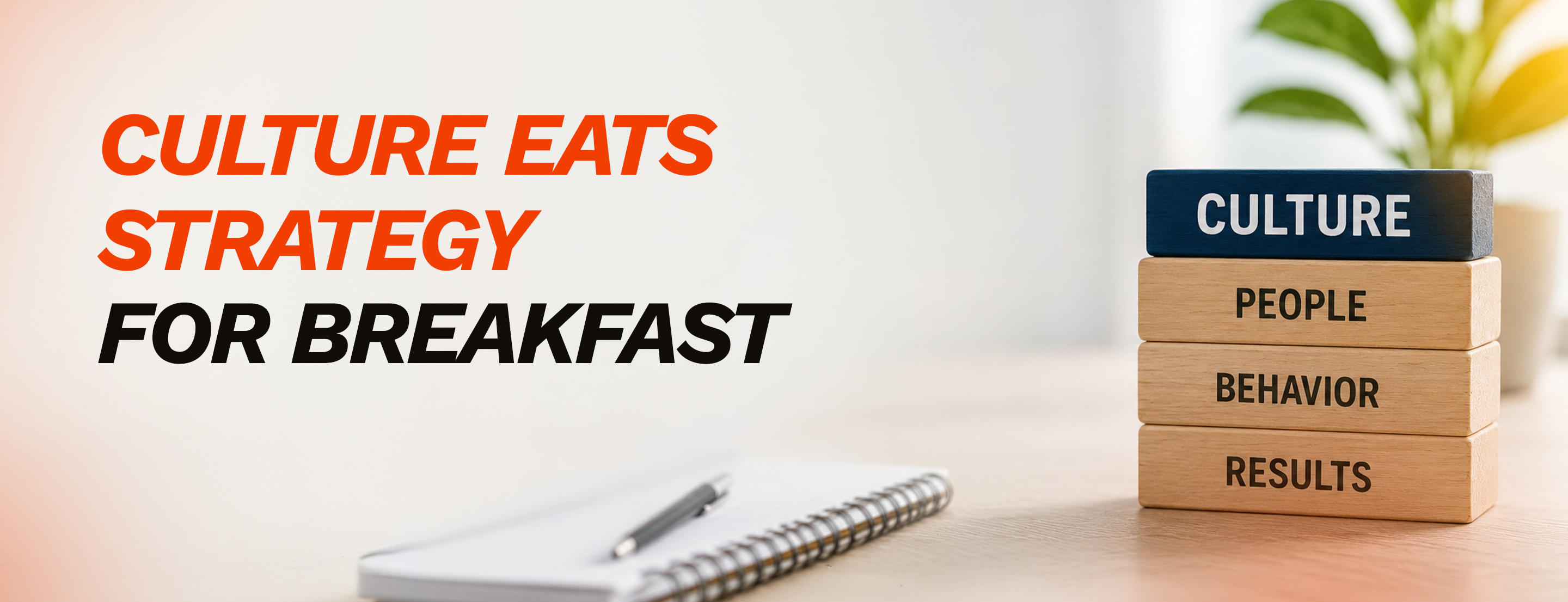
Hence the saying by Peter Drucker comes into picture “ Culture Eats Strategy for Breakfast”.
Although there's ongoing debate about whether management thinker Peter Drucker actually said these exact words, the principle behind the quote has become one of the most enduring lessons in leadership.
Why?
Because Drucker's philosophy consistently emphasized that organizations are driven by people, not processes alone. A brilliant strategy can define where a company wants to go, but only its culture determines whether people have the trust, motivation, and commitment to get it there.
And that's exactly why this idea continues to resonate with leaders across industries
Every organization has a strategy. It may be to expand into new markets, embrace AI, improve customer experience, or become the industry's most innovative company. But strategies don't execute themselves.
People do.
Culture influences how those people think, collaborate, solve problems, and respond when challenges arise. It shapes decisions that no strategic document can anticipate. One can have the best roadmap in the world, but if the team doesn't trust one another or feel empowered to act, that roadmap remains just that, a plan.
Imagine two companies with the same business objective: to deliver an exceptional customer experience.
The first company encourages employees to make decisions, supports collaboration across departments, and treats mistakes as opportunities to learn. The second has rigid hierarchies, blame-heavy meetings, and employees who hesitate to speak up because they're afraid of being wrong. Both companies share the same strategy. Only one has created the environment needed to execute it.
That's the power of culture.
Many organizations proudly display values like Integrity, Innovation, or Customer First in meeting rooms and office corridors. But culture isn't defined by what is written. It's defined by what is consistently practiced.
Culture is reflected in:
Employees don't experience culture through mission statements. They experience it through leadership behaviors.
History is filled with organizations that invested heavily in building ambitious strategies expanding into new markets, embracing digital transformation, or launching innovative products only to fall short during execution.
Why?
Because strategy defines what an organization wants to achieve, but culture determines how people behave while trying to achieve it.
Consider an organization that claims innovation is a priority, yet employees are criticized for every failed experiment. Over time, people stop taking risks. New ideas are replaced by safe choices, and innovation becomes nothing more than a word in a presentation.
Or imagine a company that proudly puts customers at the center of its strategy, but its departments operate in silos, with little communication or shared accountability. The result? A fragmented customer experience, despite the best intentions.
Similarly, an organization may aspire to be agile, but if every decision requires multiple approvals and teams are constrained by layers of bureaucracy, responsiveness becomes nearly impossible.
In each of these examples, the strategy isn't the problem.
The culture is.
When the everyday behaviors, mindsets, and values within an organization don't support its strategic goals, even the most well-designed plans struggle to succeed. Because at the end of the day, strategies don't deliver results, people do. And people are shaped by the culture they work in.
One of the biggest misconceptions is that culture belongs solely to Human Resources. It doesn't. Culture is a leadership responsibility. Every decision a leader makes sends a message. When leaders reward transparency, transparency becomes the norm. When leaders admit mistakes, accountability becomes acceptable. When leaders consistently demonstrate respect, trust begins to grow.
Conversely, when toxic behaviors are ignored, they quietly become part of the organization's identity.
As leadership expert Simon Sinek often reminds us, people don't simply follow instructions, they follow examples.
A strong culture isn't accidental. It's intentional. It requires leaders who are willing to:
When culture and strategy reinforce one another, organizations become more adaptable, resilient, and capable of sustained growth.
A strategy can tell people what needs to be achieved. Culture determines how it gets achieved.
The organizations that consistently succeed aren't necessarily those with the most ambitious strategic plans. They're the ones where people believe in the mission, trust their leaders, and feel empowered to contribute their best every day. That's why the saying has endured for decades. Because strategies can be copied. Technology can be replicated. Processes can be improved.
But a strong, healthy culture is far harder to imitate and often becomes an organization's greatest competitive advantage.

Currently working as a QA Intern at MIDCAI, I’m learning the ropes of software testing, understanding project workflows, and growing through hands-on experience in a fast-paced environment. Beyond tech, I’m deeply interested in writing, workplace dynamics, and exploring the realities of office culture through observations and conversations.
Get in touch with us for any enquiries and questions
Define your goals and identify areas where technology can add value to your business
We are looking for passionate people to join us on our mission.
where your skills fuel innovation and your growth powers ours