

There is a peculiar stage in learning something new when we often feel more confident than we probably should. We understand the basics. Things begin to make sense. A few successful attempts make us think, “I think I’ve got this.”
And then we learn more.
Suddenly, what seemed simple starts looking complicated. We notice the exceptions we had missed, the questions we had never thought to ask, and the gaps in our understanding that were invisible to us before.
Strangely enough, knowing more can sometimes make us feel less certain. This isn't necessarily a sign that we are becoming less capable. It may be a sign that our understanding is becoming more honest.
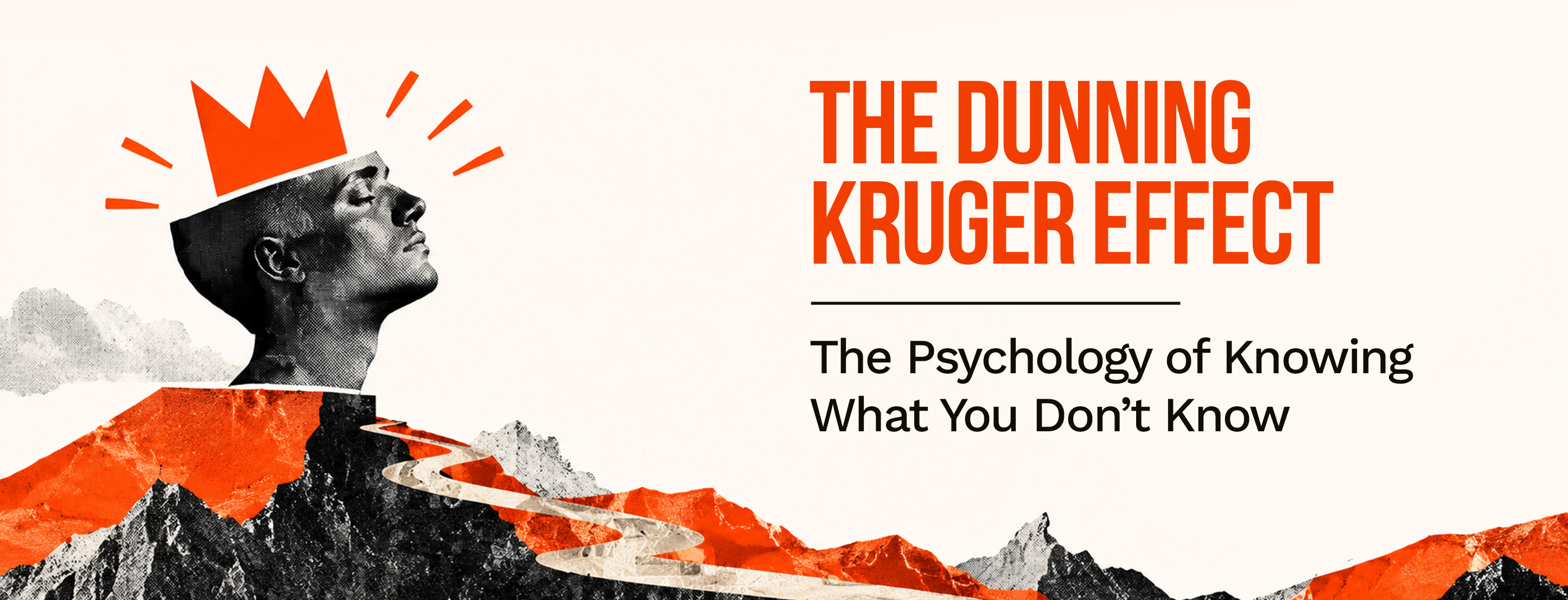
Psychologists David Dunning and Justin Kruger explored this fascinating relationship between knowledge, confidence and self-awareness, leading to what we now know as the Dunning–Kruger Effect.
And while the theory is often reduced to a joke about people being “confidently incompetent,” its deeper lesson is far more relevant to the workplace: How well do we really know what we know and what we don't?
The Dunning–Kruger Effect is a cognitive bias introduced by psychologists David Dunning and Justin Kruger in 1999. Their research explored how accurately people can judge their own knowledge and abilities.
Their work suggested something fascinating: when people have limited knowledge or skill in a particular area, they may also lack the understanding needed to recognise their own limitations. As a result, they can sometimes overestimate their ability.
As knowledge increases, however, people become better at recognising complexity, mistakes and gaps in their understanding. This is important because the Dunning–Kruger Effect is often misunderstood as simply “people who know less are more confident.” That is not quite the point.
The deeper question is about self-awareness: How accurately can we judge what we know and what we don't?
The research grew from a simple but fascinating problem: the skills required to perform well can also be the skills required to recognise poor performance.
In other words, sometimes we need knowledge not only to do something well, but also to realise that we are not doing it well. That makes self-evaluation much more complicated than it appears.
And this is precisely why the theory has such an interesting connection with professional growth.
Almost every career puts us in situations where we are beginners again. A new role. A new technology. A new project. A new industry. A new responsibility.
When we are unfamiliar with something, we don't always know what we don't know. That can create an interesting experience. At the beginning, a task may look straightforward because we can only see its surface. As we gain experience, we begin to see the layers underneath it.
A new employee might think, “I understand how this works.” Someone with years of experience might look at exactly the same situation and think, “There are several things we need to consider before we can say that.”
The second person may sound less certain. But that uncertainty can come from greater awareness, not less competence. Experience often teaches us that the more we understand a subject, the more carefully we should speak about it.
This does not mean confidence is bad. In the workplace, confidence allows us to share ideas, take responsibility, make decisions and step into unfamiliar situations. The problem begins when confidence becomes disconnected from self-awareness.
There is a difference between saying, “I know this,” and saying, “I know enough about this to understand what I still need to learn.”
The second kind of confidence may appear quieter, but it often comes with a deeper understanding of complexity. As we gain experience, we begin to realise that most problems have exceptions, dependencies and possibilities that are not immediately visible. We become more comfortable pausing before answering, asking for more information, or admitting that we are not completely sure.
That hesitation does not necessarily indicate a lack of confidence or competence. Sometimes, it reflects a more realistic understanding of what we are dealing with.
This is why confidence and competence should not always be treated as the same thing. Real professional confidence is not about believing that we know everything; it is about being secure enough to acknowledge what we don't know.
And when there is room to say “I don't know yet,” there is also room for questions, feedback, correction and learning.
Perhaps the biggest lesson is that professional growth is not simply about accumulating knowledge. It is also about improving our ability to evaluate ourselves honestly.
That is where feedback becomes important.
When we are learning, we cannot always see our own blind spots. Other people may notice something we cannot. A colleague may identify an assumption we made. A manager may point out a gap in our approach. A mentor may ask a question that exposes something we had never considered.
Feedback can be uncomfortable because it challenges the picture we have of ourselves. But if we can listen without immediately becoming defensive, it can also become a mirror.
And sometimes, the most valuable thing a mirror shows us is not what we wanted to see, but what we had failed to notice.
The same self-awareness shows up in something as simple as asking questions.
In many workplaces, saying “I don't know” can feel uncomfortable. We worry about appearing inexperienced. We want to sound capable, especially when we are surrounded by people who seem to know more than us. So sometimes, we remain quiet in a meeting even when we haven't fully understood something. But pretending to understand does not create competence. Asking a thoughtful question might.
There is a certain maturity in being able to say, “I haven't understood this part yet. Can you explain it?” It acknowledges a gap without turning that gap into an identity. This is where the idea of intellectual humility becomes important. It is not about constantly doubting ourselves or assuming that everyone else knows more. It is about being honest enough to recognise that our understanding is always capable of growing.
We may know something. We may think we know something. And sometimes, we may discover that what we thought we knew was incomplete. Being able to tell the difference is a valuable professional skill.
When we stop worrying so much about appearing knowledgeable, we can become more focused on actually becoming knowledgeable. We become more willing to ask questions, accept feedback, reconsider our assumptions and learn from mistakes.
Not knowing something is temporary. Refusing to acknowledge that we don't know it can make the gap much harder to close.
And perhaps that is where workplace growth really begins, not with having all the answers, but with having enough self-awareness to recognise when we need to look for them.
Perhaps one of the strangest things about learning is that progress does not always make us feel more certain. Sometimes, it makes us more aware of uncertainty.
At the beginning, we see a small part of the picture and think we understand the whole. With experience, the picture becomes larger—and we finally begin to see how much more there is beyond it. That awareness can feel humbling. But it can also be liberating.
Because once we are able to say “I don't know yet,” we no longer have to pretend that we do. We can ask. We can listen. We can learn. We can improve.
And perhaps that is one of the most valuable forms of workplace growth: not becoming the person who always has an answer, but becoming the person who has enough self-awareness to recognise when an answer is beyond their current knowledge.
Because knowing what you don't know is not the opposite of expertise. Sometimes, it is one of the clearest signs that you are on your way towards it.

Currently working as a QA Intern at MIDCAI, I’m learning the ropes of software testing, understanding project workflows, and growing through hands-on experience in a fast-paced environment. Beyond tech, I’m deeply interested in writing, workplace dynamics, and exploring the realities of office culture through observations and conversations.
Get in touch with us for any enquiries and questions
Define your goals and identify areas where technology can add value to your business
We are looking for passionate people to join us on our mission.
where your skills fuel innovation and your growth powers ours