

“Apparently, to belong, you're supposed to adjust a little. The problem begins when ‘a little’ becomes your entire personality.”
For a long time, I thought belonging meant learning how to fit in.
Be cooperative. Be helpful. Listen more. Adjust when needed. Don't contradict people unnecessarily. Don't make things difficult. It sounds reasonable.
And, to an extent, it is.
We all adjust when we become part of a team, a friendship, a family, or any community. We learn that not every opinion needs an argument, not every difference needs to be highlighted, and not every situation needs to go our way. Sometimes, belonging means meeting people halfway.
But there is a point where adjustment can quietly turn into self-suppression.
You start agreeing even when you don't completely agree. You stay silent because saying what you really think might create unnecessary conflict. You participate because you don't want to appear uninterested. You become more careful about what you say, how you say it, and how others might perceive you.
And sometimes, you don't even notice when it starts happening. You simply tell yourself, “It's okay. Let it go. Maybe this isn't worth it.” Until one day, you walk away from a situation and realize that what is bothering you isn't what someone else said or did.
It's the fact that you didn't say what you wanted to say.
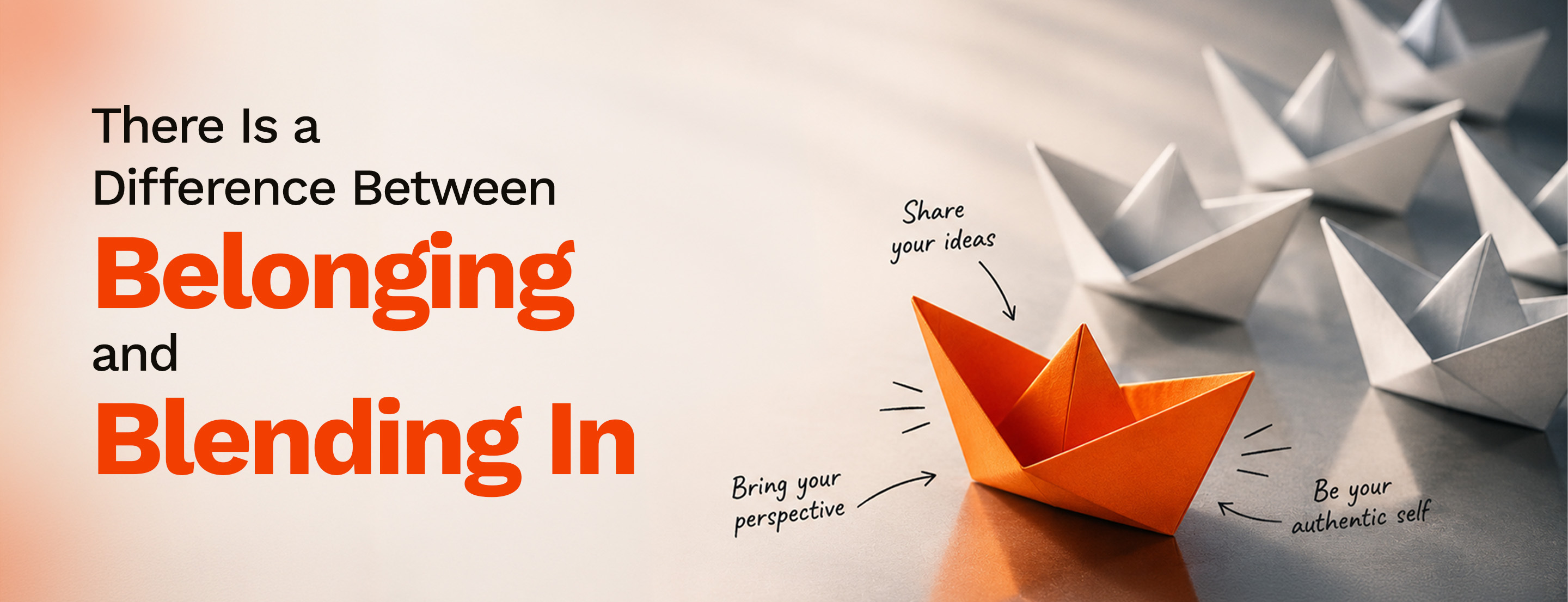
That's when I started thinking about the difference between belonging and blending in.
Because being part of something will always require some adjustment. But does belonging really mean becoming a version of yourself that is easier for everyone else to accept?
I don't think it should. And I'm still learning the difference.
Being part of a group requires compromise. You listen to other people's perspectives. You sometimes let small things go. You understand that your way isn't always the only way.
That's healthy.
In fact, I think some amount of blending is necessary for belonging. If everyone insists on doing exactly what they want, no team can function.
But belonging shouldn't mean that you have to agree with everything just because everyone else does.
You can listen without agreeing. You can respect someone without accepting every opinion they have. You can cooperate without completely surrendering your own perspective.
The goal isn't to stand apart from everyone. It's to remain yourself while standing with everyone.
I don't think anyone wakes up one morning and decides, “From today, I am going to suppress myself.” It happens much more quietly.
You disagree with something, but decide not to say it because the timing doesn't feel right. Someone says something you don't agree with, and you simply nod. You participate in conversations you don't particularly enjoy because you don't want to seem disconnected. You become careful about how much of yourself you reveal. And every time, there is a perfectly reasonable explanation.
It's not worth arguing.
Maybe I'm overthinking it.
I'm still learning.
I don't want to be difficult.
Sometimes, those explanations are actually valid. Maturity does require knowing which battles deserve your energy. But there is a difference between choosing silence and being afraid of your own voice.
I have experienced both.
The difficult part is recognizing which one you're practising at that moment. Because when you repeatedly choose silence to avoid being misunderstood, something strange happens. The conversation ends, everyone moves on, and outwardly, everything seems perfectly fine.
But you don't.
You keep replaying the situation in your head. I should have said that. Why didn't I say anything? Maybe I should have spoken up.
And eventually, you realize that the discomfort isn't really about disagreement. It is about knowing you weren't entirely honest with yourself.
There is also a strange social pressure around being easy to work with. We appreciate people who cooperate. We like people who don't create unnecessary friction. We call them flexible, understanding, and mature.
And those are good qualities.
But somewhere between being understanding and being agreeable, the distinction can get blurry.
A person who contradicts everything simply to oppose others may genuinely be difficult. But someone who occasionally says, “I see it differently,” isn't necessarily difficult. Maybe they are simply contributing another perspective.
I've started to believe that disagreement is not the opposite of belonging. Sometimes, disagreement is actually evidence that you feel secure enough to participate honestly. The real question isn't whether everyone agrees. It is whether people can disagree without making each other feel that they no longer belong.
My understanding of workplace belonging used to be quite straightforward. Be a good team member. Do your work sincerely. Help people. Take help when you need it. Follow the rules. Contribute. Make an effort. I still believe in all of that.
But experience adds another layer to the picture. You begin noticing that not everyone occupies the same position in a room. Some people have more authority, more experience, more confidence, or simply more perceived value. Their opinions naturally carry more weight. And when you're still building your own confidence, it can become tempting to make yourself smaller rather than risk being misunderstood.
For me, that becomes even more complicated when I know I'm learning and genuinely value the opportunity I've been given. Gratitude can make you patient. Sometimes, it can also make you tolerate more than you normally would.
You think: This is a good opportunity. I am learning here. Maybe I shouldn't complain. Maybe I should just adjust. There is nothing wrong with being grateful.
But I am slowly learning that gratitude and silence don't have to come together. I can appreciate an opportunity and still have an opinion about my experience within it. I can respect the people around me and still question something I believe is wrong. I can be part of the team without agreeing with every voice in it.
For a long time, I had a very specific idea of what confidence looked like. It was someone who could speak without hesitation, disagree without overthinking, walk into a room without worrying about how they would be perceived, and simply say what they thought.
I used to think that was confidence.
But I am beginning to understand that confidence can be much quieter. Sometimes, confidence is not about speaking more. It is about being able to speak when it actually matters. It is being able to say, “I see it differently,” without immediately wondering if you have said too much. It is being able to question something without turning it into a confrontation. It is being able to disagree without feeling that you have somehow become difficult. And it is knowing that you can be respectful, calm, and still stand by what you believe.
I am still learning this.
There are moments when I choose silence because it feels easier. Moments when self-doubt makes me question whether my opinion is important enough to be expressed. Moments when I tell myself that perhaps adjusting is simply part of belonging.
But I am slowly realizing that confidence doesn't mean having an answer for everything or speaking at every opportunity.
Sometimes, it is simply trusting yourself enough to say something when you genuinely feel something is wrong. Not to prove a point. Not to win an argument. Not to make someone else feel wrong. Just to make sure that, in the process of trying to belong, you haven't completely silenced yourself.
Maybe that is the kind of confidence I am trying to build, not the confidence to challenge everything, but the confidence to speak when it matters and remain at peace with myself afterward.
There is another lesson I am still learning: speaking up does not mean reacting to everything.
Sometimes a disagreement is worth addressing. Sometimes it isn't. Sometimes you have the energy to explain yourself, and sometimes protecting your peace is more valuable than proving your point. I think maturity is not simply knowing when to speak and when to stay silent. It is understanding why you are choosing either one.
Am I staying quiet because this genuinely doesn't matter? Or because I'm afraid of being perceived differently?
Am I compromising because I value the relationship? Or because I'm afraid of losing my place in it?
The answers aren't always comfortable. But perhaps that's what self-awareness is meant to do. Help us distinguish peace from avoidance and compromise from self-suppression. And somewhere in all of this, mental health matters too.
We spend so much time trying to be good colleagues, good team members, understanding people, flexible people, professional people. But we don't always stop to ask: What is all this adjustment costing me?
You can smile through a conversation and still carry it home with you. You can say “It's okay” and spend the next hour replaying it in your head. So, whatever the situation, khud ko itna pareshan mat karo ki the situation becomes more important than your peace.
Speak when you need to. Compromise when it genuinely matters. Let go when it doesn't. Not every disagreement needs a battle. Not every person needs to be convinced. And not every situation needs to be carried with you.
Sometimes, protecting your peace isn't giving up. It's simply deciding that not everything deserves your breath. And after all the effort to belong, your mental health still deserves a place at the table.
Perhaps belonging is about making room for other people's opinions, personalities, perspectives, and ways of working without constantly making yourself smaller in the process.
I am still learning that balance.
I still adjust. I still stay quiet sometimes. I still second-guess myself. But I am slowly understanding that being cooperative doesn't mean being voiceless, being grateful doesn't mean tolerating everything, and disagreeing doesn't automatically make me difficult. Sometimes belonging means meeting people halfway. Sometimes it means respectfully standing your ground.
And sometimes, it means knowing when to let something go, not because you don't have a voice, but because you have decided that your peace matters more.
I don't have to agree with everyone to belong. I don't have to fight everyone to prove that I am different. And I don't have to become someone else just to be accepted.
I can adjust without disappearing. I can speak without fighting. I can let go without feeling like I lost. Because perhaps true belonging isn't about blending in so perfectly that nobody notices you.
It is about being able to stand among others, contribute, grow, and still recognize yourself when you look within. And if belonging ever asks me to lose that person completely, perhaps it is worth asking whether I am really belonging or simply blending in.

Currently working as a QA Intern at MIDCAI, I’m learning the ropes of software testing, understanding project workflows, and growing through hands-on experience in a fast-paced environment. Beyond tech, I’m deeply interested in writing, workplace dynamics, and exploring the realities of office culture through observations and conversations.
Get in touch with us for any enquiries and questions
Define your goals and identify areas where technology can add value to your business
We are looking for passionate people to join us on our mission.
where your skills fuel innovation and your growth powers ours

.jpg)