

Deals do not wait for the CRM to catch up.
A prospect replies, a meeting changes the next step, or a close date moves and someone still has to update every detail by hand.
Agentforce Sales, formerly Salesforce Sales Cloud, is built for everything that happens between one customer conversation and the next.
It brings the main parts of the sales process together in one place. Reps spend less time chasing information, while managers get a clearer view of what is happening across the pipeline.
This guide explains what Agentforce for Sales is, how it works, and what its features, benefits, editions, and pricing look like.
Agentforce Sales is Salesforce’s platform for managing leads, customers, deals, and sales activity in one place. It was previously called Salesforce Sales Cloud.
Sales teams can use it to:
What makes Agentforce Sales different is the role AI agents now play alongside sellers. They can support tasks such as prospecting, lead nurturing, account research, pipeline updates, and sales coaching using the information already available in Salesforce.
So, it is still the CRM where teams manage customers and deals. It now also helps carry some of the work between one sales conversation and the next.
Agentforce Sales keeps the core CRM foundation of Salesforce Sales Cloud, then adds AI agents that can research prospects, nurture leads, prepare sellers, update opportunities, support quoting, and guide partners.
Here is how these capabilities fit across the sales cycle.
Building pipeline usually starts with research, outreach, and several follow-ups before a prospect is ready to meet. Agentforce Sales can take on more of this early-stage work.
Once a deal is active, the challenge shifts from finding prospects to keeping the account context, next steps, and opportunity records current.
Agentforce Sales also extends Salesforce AI for sales into partner-led revenue. Partners can get more support without waiting for an internal channel manager to answer every question.
The main change is not that Agentforce Sales replaces the CRM features teams already use. It adds a working layer of Salesforce sales AI that can act on that information and help move sales work forward.
Agentforce Sales helps sales teams do more with the data already in Salesforce. It supports the work around a deal, such as research, follow-ups, meeting preparation, pipeline updates, and coaching, so reps can spend more time with customers.
Sales reps often lose time switching between account research, CRM updates, follow-up tasks, and meeting preparation.
Agentforce for Sales can support these routine activities in the background. Reps get the context they need faster and can spend more of their day speaking with prospects, understanding customer needs, and moving active deals forward.
A lead may respond after business hours or need several follow-ups before they are ready to meet a rep. When every conversation depends on manual outreach, some leads can easily go quiet.
Agentforce lead nurturing can continue follow-ups, answer common questions, and help schedule meetings. This keeps the conversation active while giving reps the right context when it is time to step in.
Not every account, lead, or opportunity deserves the same level of attention. Reps need a clear way to understand where their time can make the biggest difference.
Agentforce prospecting can help prioritise relevant accounts and contacts, while pipeline agents surface deals that are slowing down or need action. This gives teams a more focused place to start.
Pipeline reviews become less useful when opportunity records do not match what is happening in emails, calls, and meetings.
Agentforce pipeline management can review recent activity and suggest updates to stages, close dates, next steps, and follow-ups. This gives managers a clearer view of deal movement and reduces the time reps spend updating records before every review.
Preparing for a meeting often means checking account records, previous conversations, open opportunities, and unresolved tasks across different places.
Agentforce Sales can bring this information into one clear summary. Reps can enter the conversation with a better understanding of the customer, recent activity, and what needs to happen next.
General sales training does not always prepare a rep for the deal they are working on today.
Agentforce Sales Coach can use opportunity context to run role-plays and provide feedback around objections, pricing, proposals, and customer questions. This makes coaching more connected to real sales conversations.
Sales teams still need to understand what an agent has done and why.
Agentforce Sales can show agent recommendations and the information used to support them. Reps can review, edit, accept, or reject suggested updates, keeping important decisions visible and under their control.
Sales teams may work with resellers, distributors, brokers, or other partners who need quick access to product information, training, and deal support.
Agentforce Sales can help partners find answers and move opportunities forward without waiting for an internal team. Direct and partner-led deals also remain connected in the same platform, giving leaders a wider view of the pipeline.
Salesforce Sales Cloud uses a per-user, per-month pricing model. Each edition builds on the previous one, adding more room for automation, customization, pipeline management, analytics, integrations, and AI.
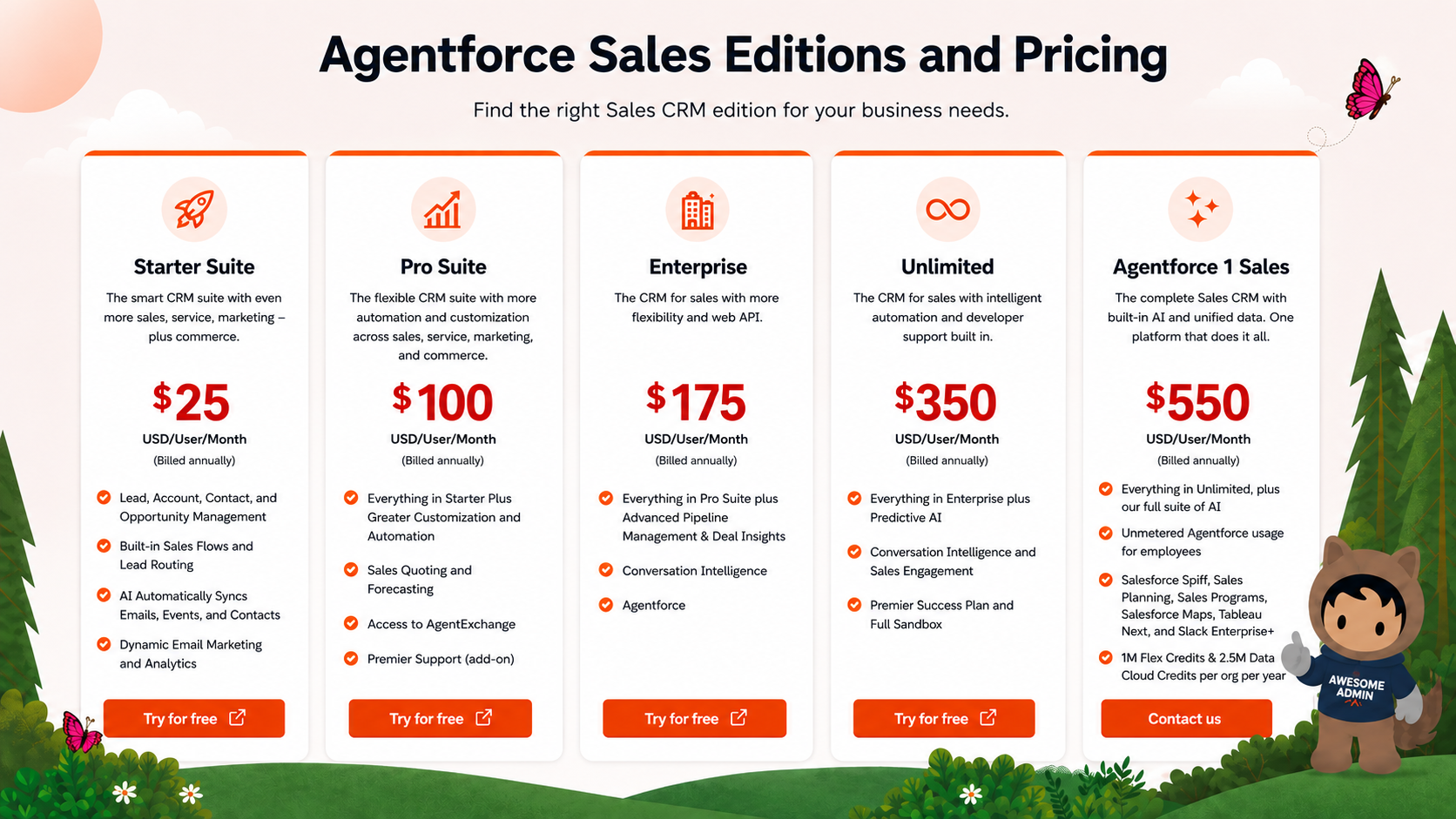
Free Suite provides an entry point for teams beginning with Salesforce. However, Salesforce highlights Starter Suite as its main paid starting plan.
Starter Suite includes the records sales teams use every day, including leads, accounts, contacts, and opportunities. It also adds lead routing, built-in sales flows, email and event synchronization, and connected marketing and service capabilities.
Pro Suite gives growing teams more control over how Salesforce works. It includes greater customization and automation, along with sales quoting and forecasting.
This edition fits teams that have moved beyond basic record management but do not yet need the advanced pipeline, API, and AI capabilities available in Enterprise.
Enterprise is designed for sales operations that need more flexibility and deeper connectivity. It adds advanced pipeline management, deal insights, conversation intelligence, and web API access.
Salesforce also makes Agentforce capabilities available for purchase at this level, making Enterprise an important starting point for organizations planning broader AI use across sales.
Unlimited builds on Enterprise with predictive AI, Sales Engagement, conversation intelligence, a full sandbox, and the Premier Success Plan.
It suits organizations that need more sales intelligence, higher testing capacity, and stronger support built into the edition rather than purchased separately.
Agentforce 1 Sales combines the Unlimited edition with Salesforce’s wider AI, data, analytics, planning, incentive management, mapping, and collaboration products.
It includes unmetered employee Agentforce usage, Slack Enterprise+, Tableau Next, Sales Planning, Salesforce Maps, Salesforce Spiff, and annual Flex Credit and Data Cloud Credit entitlements.
Salesforce currently prices Flex Credits at $500 per 100,000 credits, while each standard Agentforce action uses 20 credits. Actual consumption depends on how often agents act and how many actions each use case requires.
Choosing an edition therefore starts with the sales process, not the longest feature list. A team that mainly needs contact and pipeline management has very different requirements from one using advanced forecasting, partner selling, data unification, and AI agents across the sales cycle.
Agentforce Sales can take a lot off a sales team’s plate, but only when the data, stages, and workflows behind it are set up properly.
Through our Agentforce consulting services, we help teams connect their sales process with the right data, automation, integrations, and reporting.
The result is not just another AI feature inside Salesforce. It is a sales setup where reps spend less time on admin, managers get a clearer pipeline, and agents have the context to be genuinely useful.
Make Agentforce Sales do more than look impressive in a demo. Talk to our Salesforce consultants.

5+ years of experience in content strategy, marketing, and technical communication. At MIDCAI, I focus on turning ideas around Salesforce, data, and AI into clear, actionable insights that help enterprises attract the right audience and drive real adoption.
Got questions? We’ve got answers. Explore common queries to understand how we work and what to expect.
Agentforce Sales is Salesforce’s platform for managing leads, accounts, opportunities, sales activity, forecasts, and revenue. Formerly known as Salesforce Sales Cloud, it now combines its core CRM capabilities with AI agents that support work across the sales cycle.
Agentforce Sales is Salesforce Sales Cloud’s current evolution, not a separate CRM. It includes the familiar tools for managing leads, accounts, opportunities, forecasts, and territories, while adding stronger AI-driven capabilities.
Its agents can research prospects, update records, recommend next steps, and support sellers throughout the sales cycle with less manual work.
AI agents can help research prospects, follow up with leads, prepare sellers for meetings, suggest opportunity updates, support quoting, and guide partner teams. The tasks an agent can complete depend on its role, instructions, permissions, and access to business data.
Agentforce Sales can reduce the time reps spend on research, follow-ups, meeting preparation, and CRM updates. It also helps teams respond to leads faster, keep pipeline information current, and give sellers clearer context before customer conversations.
The cost depends on the Salesforce edition and AI capabilities selected. Salesforce currently lists Sales editions from Free Suite at $0 to Agentforce 1 Sales at $550 per user per month. The Agentforce for Sales add-on starts at $125 per user per month, while additional usage-based charges may apply.
Get in touch with us for any enquiries and questions
Define your goals and identify areas where technology can add value to your business
We are looking for passionate people to join us on our mission.
where your skills fuel innovation and your growth powers ours