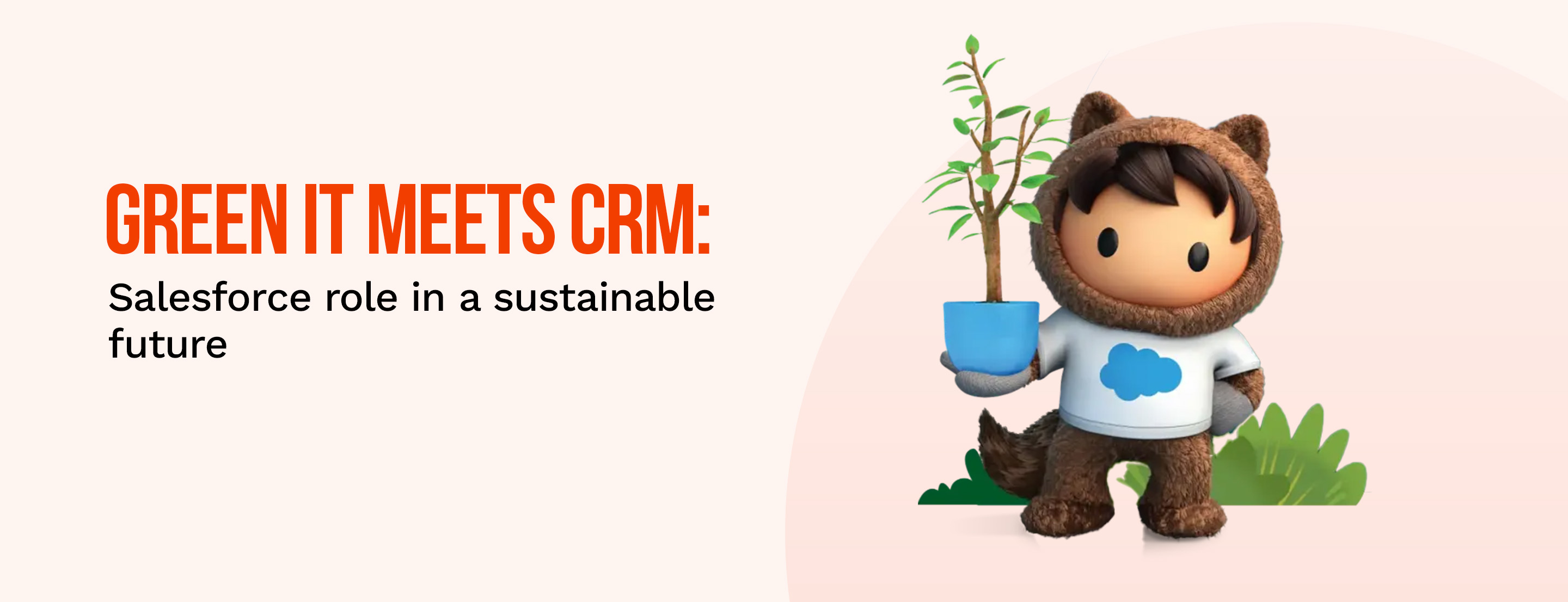


Sustainability is no longer a side conversation in technology, it is a strategic imperative. As enterprises scale their digital operations, the environmental footprint of IT infrastructure, data storage, and customer engagement platforms becomes increasingly visible. This is where Green IT intersects with Customer Relationship Management (CRM).
Salesforce, as one of the world’s leading cloud-based CRM platforms, sits at the center of this intersection. By design, cloud-native CRMs influence how data is stored, processed, and accessed, directly impacting energy consumption, hardware usage, and operational efficiency. Understanding Salesforce’s role in sustainable IT helps organizations align customer-centric growth with environmental responsibility.
Green IT refers to the way information technology is designed, operated, and eventually retired with the goal of reducing its environmental impact. In an enterprise context, it is not limited to energy-efficient hardware alone, it extends to how digital systems are architected, scaled, and used on a daily basis.
In practice, Green IT initiatives focus on:
This is where CRM platforms become highly relevant. CRM systems sit at the core of modern business operations, managing vast amounts of customer data, interactions, and analytics. The way a CRM is built and deployed directly influences how much infrastructure is required, how efficiently data is processed, and how sustainably an organization can operate at scale.
Modern CRM platforms are not passive databases but they are always-on digital engines that run core business functions. From managing sales pipelines and powering marketing automation to enabling customer service operations, analytics, and AI-driven decision-making, CRM systems touch nearly every customer interaction an organization has.
Because of this central role, the environmental impact of a CRM system is often underestimated. A poorly designed or inefficient CRM architecture can quietly become a sustainability liability.
In such environments, organizations often experience:
Each of these issues increases energy usage, operational complexity, and long-term carbon footprint, often without delivering proportional business value.
A cloud-based CRM like Salesforce fundamentally changes this dynamic. By centralizing customer data on a shared, cloud-native platform, Salesforce shifts infrastructure management away from individual organizations and into a highly optimized, centrally managed environment. Compute, storage, and networking resources are allocated dynamically based on real demand, rather than fixed capacity planning.
This approach delivers sustainability benefits at multiple levels:
As a result, CRM moves from being just a customer engagement tool to becoming a strategic enabler of sustainable digital operations. When implemented thoughtfully, CRM platforms help organizations grow customer relationships while simultaneously reducing the environmental cost of doing business.
At the heart of Salesforce’s sustainability impact lies its cloud-native, multi-tenant architecture. This architectural model is not just a technical choice, it is a foundational enabler of efficiency, scale, and reduced environmental impact.
Shared Infrastructure Efficiency
Unlike traditional on-premise CRM systems or single-tenant cloud deployments where each organization maintains its own isolated infrastructure, Salesforce operates on a shared platform model. In a multi-tenant environment:
This shared-resource approach results in far higher utilization rates than conventional enterprise data centers. Instead of thousands of underused servers consuming power around the clock, resources are pooled and optimized at scale. The outcome is lower energy consumption per customer, without compromising performance, reliability, or security.
Reduced On-Premise Footprint
Adopting Salesforce also fundamentally changes how organizations manage their physical IT footprint.
By moving CRM workloads to a cloud-native platform:
This shift removes the need for organizations to operate and continuously upgrade their own CRM infrastructure: one of the most resource-intensive aspects of enterprise IT.
From a sustainability perspective, the impact is direct and measurable. Fewer servers mean lower electricity consumption, reduced cooling needs, and less hardware entering disposal streams. Collectively, this leads to a smaller operational carbon footprint, while still supporting business growth and increasing customer engagement.
In this way, Salesforce’s architecture demonstrates how modern CRM platforms can deliver scale and performance without a proportional increase in environmental cost; a core principle of Green IT in practice.
Beyond platform architecture, Salesforce has made environmental responsibility a core part of how it operates as a global cloud provider. Rather than treating sustainability as a secondary initiative, it is embedded into how Salesforce powers, scales, and reports on its operations.
Key elements of this commitment include:
This centralized approach to sustainability has an important downstream effect for customers. Organizations running their CRM workloads on Salesforce benefit from greener infrastructure by default, without having to individually negotiate renewable energy contracts, manage offset programs, or build sustainability capabilities at the IT infrastructure level.
For many enterprises, especially those without large sustainability teams, this significantly lowers the barrier to adopting more environmentally responsible technology. Instead of each company solving the same infrastructure-level challenges independently, Salesforce absorbs that complexity at scale.
As a result, sustainability becomes an inherent characteristic of the platform, not an added operational burden for customers. This model allows businesses to focus on customer engagement and growth, while simultaneously aligning their digital operations with broader environmental goals.
Data Centralization and Deduplication
Salesforce encourages a single source of truth for customer data. Features such as data models, identity resolution, and governed integrations help reduce:
Less duplicated data means lower storage requirements and reduced processing overhead.
Intelligent Automation Over Manual Processes
Salesforce automation tools such as flows, process automation, and marketing journeys, replace manual, paper-driven, or spreadsheet-heavy workflows. This results in:
Customer engagement, analytics, and sustainability measurement are often treated as separate initiatives. In reality, they are deeply interconnected,and Salesforce brings them together on a single platform.
Marketing activities, in particular, can carry hidden environmental costs when they rely on print-based outreach, physical distribution, or poorly targeted digital campaigns. Salesforce Marketing Cloud helps address this by enabling a digital-first, data-driven approach to customer engagement. Physical mailers and mass communication are replaced with targeted digital journeys that reach the right audience at the right time.
Through precise segmentation and personalization:
Fewer, better-targeted interactions translate into lower digital noise and more responsible use of infrastructure.
Salesforce further strengthens this impact through its AI and analytics capabilities, including Einstein. By analyzing customer, operational, and behavioral data, AI supports smarter decision-making across the business. This includes improved demand forecasting that helps reduce overproduction and excess inventory, predictive service models that minimize repeat visits and wasted effort, and insights that streamline sales, service, and supply chain operations.
When decisions are informed by accurate data and predictive intelligence, organizations avoid inefficiencies that often result in wasted time, materials, and energy. Sustainability, in this context, becomes a byproduct of operational excellence.
Salesforce extends this philosophy into formal sustainability management through Sustainability Cloud. Rather than treating environmental metrics as disconnected reports, Sustainability Cloud allows organizations to track carbon emissions, manage ESG data, and integrate sustainability metrics directly into core business processes.
By handling sustainability data with the same structure, governance, and visibility as customer data, organizations can move environmental accountability closer to everyday decision-making. Sustainability is no longer measured after the fact, it becomes part of how the business operates.
Together, these capabilities demonstrate how Salesforce enables organizations to engage customers responsibly, operate intelligently, and measure what truly matters without separating sustainability from growth.
The Broader Impact: Enabling Sustainable Business Models
Salesforce does not just reduce IT-related emissions, it enables new ways of working:
These systemic changes contribute to long-term sustainability beyond the IT department.
Sustainability in technology is no longer confined to energy-efficient data centers or carbon reporting frameworks. It is increasingly shaped by how core business platforms are designed, deployed, and scaled. CRM systems, sitting at the center of customer engagement and enterprise operations, play a far more critical role in this shift than they are often given credit for.
Salesforce demonstrates how a cloud-native, multi-tenant CRM can support business growth while actively reducing environmental impact. Through shared infrastructure, centralized data management, intelligent automation, and renewable-powered operations, Salesforce helps organizations decouple digital expansion from proportional increases in energy use and resource consumption.
More importantly, Salesforce integrates sustainability directly into everyday business processes. From reducing redundant data and manual workflows to enabling smarter decisions through AI and analytics, sustainability becomes an outcome of operational efficiency and not a separate initiative running in parallel. With Sustainability Cloud, environmental accountability is treated with the same rigor as customer and revenue data, embedding responsibility into how organizations measure success.
As enterprises continue to scale their digital footprint, the convergence of Green IT and CRM will only become more significant. Salesforce’s approach shows that customer-centric technology and environmental responsibility are not competing priorities. When implemented thoughtfully, they reinforce each other.
In a future where growth, intelligence, and sustainability must coexist, CRM is no longer just a system of engagement. It is a strategic foundation for building businesses that are resilient, responsible, and ready for what comes next.

Working as Manager – People and Admin in a dynamic environment at MIDCAI, I’m passionate about creating people-first processes, building purposeful teams, and driving operational efficiency. I thrive on meaningful collaboration and continuous learning. Whether it’s supporting team growth, creating systems that empower people, or adapting to a rapidly evolving tech landscape, I bring heart and hustle to every challenge.
Get in touch with us for any enquiries and questions
Define your goals and identify areas where technology can add value to your business
We are looking for passionate people to join us on our mission.
where your skills fuel innovation and your growth powers ours