

Agentforce can already take action inside Salesforce. The next challenge is making sure it knows which action makes sense in the first place.
That is where Koa comes in.
Koa is Salesforce’s new CRM reasoning model, built on NVIDIA Nemotron 3 Super and trained for multi-step enterprise workflows, tool use, and CRM tasks.
In simple terms, Salesforce now has a model designed around how CRM work actually happens, not just how general AI reasons.
So, what makes Koa different, and where does it fit into Agentforce?
Salesforce Koa is a CRM reasoning model built for Agentforce. It helps agents work through multi-step tasks, choose the right tools, and decide what should happen next.
Koa is built on NVIDIA Nemotron 3 Super, an open model that Salesforce further trained for CRM and enterprise workflows.
Instead of building a foundation model from scratch, Salesforce used synthetic business scenarios based on how CRM work happens across sales, service, and other customer-facing processes.
These scenarios cover tasks like qualifying leads, managing opportunities, and resolving service cases across more than 14 industries.
And importantly, Salesforce says customer data was not used to train Koa.
Simply put, Agentforce is where the agent runs. Koa is one of the models that can help it reason through the work.
General-purpose AI models are good at a lot of things. But that also means they approach CRM work as just another problem to solve.
Salesforce wanted something more specialized.
CRM tasks usually follow specific rules and processes. Qualifying a lead, updating an opportunity, or resolving a service case often requires several steps, different tools, and a clear understanding of what should happen next.
Until now, much of that reasoning in Agentforce was handled by general-purpose models. Koa was built to bring that reasoning closer to the work itself.
Instead of figuring out every CRM task from scratch, Koa has been trained around repeatable enterprise workflows, including when to take action and when to stop or hand the task to a person.
Koa helps an Agentforce agent work through a task step by step. Here is what that can look like:
Koa first identifies what the user is trying to get done.
It looks at the instructions, CRM data, and information available to the agent.
Based on the task, Koa decides which action needs to happen next.
Once the action is completed, it uses that result to decide the next step.
Koa keeps moving through the workflow until the job is done.
If the right tool or information is missing, Koa is trained to stop, ask for what is needed, or hand the task over instead of taking the wrong action.
So, Koa is not just generating a response. It is helping the agent reason through the work behind that response.
Salesforce did not build Koa from scratch. It started with NVIDIA Nemotron 3 Super and trained it further for CRM and enterprise workflows.
Instead of using customer data, Salesforce created synthetic business scenarios that reflect tasks agents may handle, such as updating opportunities, resolving cases, and working through multi-step processes across more than 14 industries.
Salesforce used two main training approaches:
For reinforcement learning, Salesforce used Group Relative Policy Optimization (GRPO) with NVIDIA’s NeMo tools.
The focus was on helping Koa learn how to complete CRM tasks correctly, not just generate a good response.
Koa is built for CRM work that involves more than one step. Its capabilities are focused on helping Agentforce agents reason through tasks, use tools correctly, and stay on track as the workflow moves forward.
Many CRM tasks are not completed with a single action.
An agent may need to check a record, review customer context, take an action, look at the result, and then decide what comes next. Koa is trained to reason through these steps as part of one workflow instead of treating each action separately.
Agentforce agents can have access to multiple tools and actions. Koa helps decide which one is appropriate for the task at hand.
For example, if an agent needs to update an opportunity, retrieve account information, or work on a service case, Koa can use the available context to choose the relevant action.
Koa is trained around CRM and enterprise workflows rather than general-purpose tasks.
Its training includes scenarios related to sales, service, lead management, opportunity management, case resolution, and other customer-facing processes. This gives the model more context around how CRM work is structured and how one action connects to the next.
Some tasks involve several messages, actions, and changes before they are complete.
Koa is designed to keep track of that context as the interaction continues. This helps the agent use what has already happened when deciding the next step instead of starting from scratch each time.
Taking the wrong action can be worse than taking no action at all. Koa is also trained for situations where the correct tool, information, or permission is not available.
In those cases, it can stop, ask for what is missing, or hand the task over instead of choosing an unrelated action just to continue the workflow.
Koa is not limited to one CRM use case.
Salesforce has trained and tested it across workflows that can apply to areas such as sales, service, employee support, web agents, and other enterprise processes. The common thread is the same, i.e. to help an Agentforce agent make better decisions as it works through a task.
Koa and Agentforce work together, but they play very different roles.
Agentforce is the platform where agents are built and run. Koa is the reasoning model that can power how those agents make decisions.
Salesforce is making Koa available in a few different places, depending on how broadly you want to use it.
Koa can be selected as the model for an agent, sub-agent, or agent router inside Agentforce Builder.
This gives teams more flexibility to use Koa only where CRM-specific reasoning is needed, while using other supported models for different parts of the agent.
Koa can also be selected as a model provider across an entire Salesforce org.
Once enabled, it can be applied across agents rather than configured separately for each one. Salesforce says customers will opt in to Koa just like they do with other model providers.
Koa is also planned as a managed model in the Data Cloud Generative Models catalogue.
From there, it can be used across AI applications, prompts, and agents, giving teams another way to bring Koa into Salesforce experiences beyond a single Agentforce configuration.
Salesforce is already using Koa internally, including with its Employee Agent in Slack, and has started pilots with select customers.
Koa gives Salesforce a reasoning model that is built specifically for CRM work. And that makes things interesting for teams already using Agentforce. The question is no longer just which model to use, but where Koa actually fits best.
Maybe that is a specific workflow. Maybe it is a sub-agent handling a more complex task. Or maybe another model still makes more sense in some places.
That is the part worth figuring out.
At MIDCAI, we help businesses make those decisions through Agentforce consulting, from choosing the right workflows to connecting the data, actions, integrations, and models behind them.
Curious where Koa could fit into your Agentforce setup? Let’s figure it out together.

5+ years of experience in content strategy, marketing, and technical communication. At MIDCAI, I focus on turning ideas around Salesforce, data, and AI into clear, actionable insights that help enterprises attract the right audience and drive real adoption.
Got questions? We’ve got answers. Explore common queries to understand how we work and what to expect.
Koa is available to select Agentforce pilot customers now, with customer pilots beginning in October 2026. Salesforce expects general availability in U.S. regions in winter 2026.
No. Koa is one selectable model among the models Agentforce supports. Teams can apply it to a specific agent, sub-agent, or agent router where CRM reasoning matters, and continue using other supported models elsewhere.
No. Salesforce built Koa's training corpus from synthetic business scenarios modelled on its CRM experience rather than real customer records. Salesforce also controls the model weights and runs post-training and inference inside its own trust boundary.
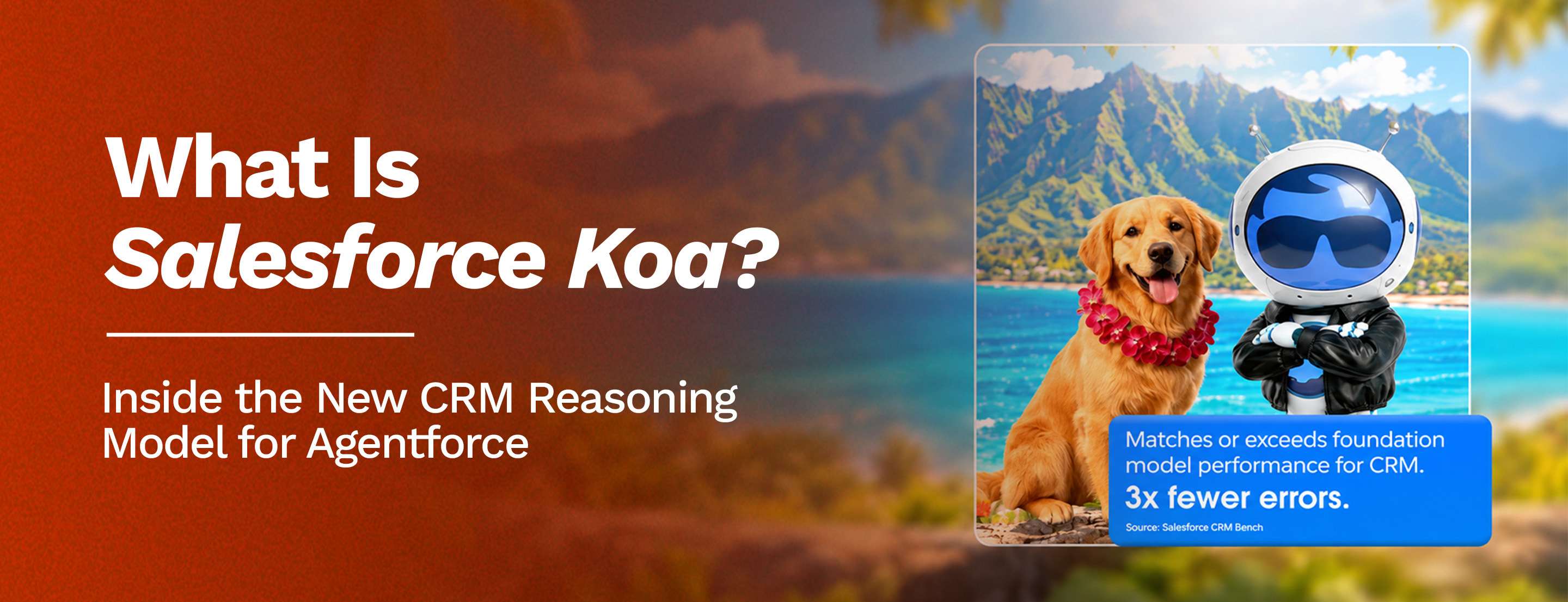
Salesforce says Koa matches or exceeds leading model performance on CRM actions with three times fewer errors. That figure comes from Salesforce's own CRM Benchmark, which covers tasks such as updating an opportunity, routing a case, and scheduling a follow-up. No independent benchmark results are available yet.
Get in touch with us for any enquiries and questions
Define your goals and identify areas where technology can add value to your business
We are looking for passionate people to join us on our mission.
where your skills fuel innovation and your growth powers ours