

AI agents are getting access to more than FAQs and knowledge articles.
They can work with customer records, conversations, business rules, transactions, permissions, and other sensitive company data. And once an agent can use that context to take action, security gets a little more complicated than deciding who can log into Salesforce.
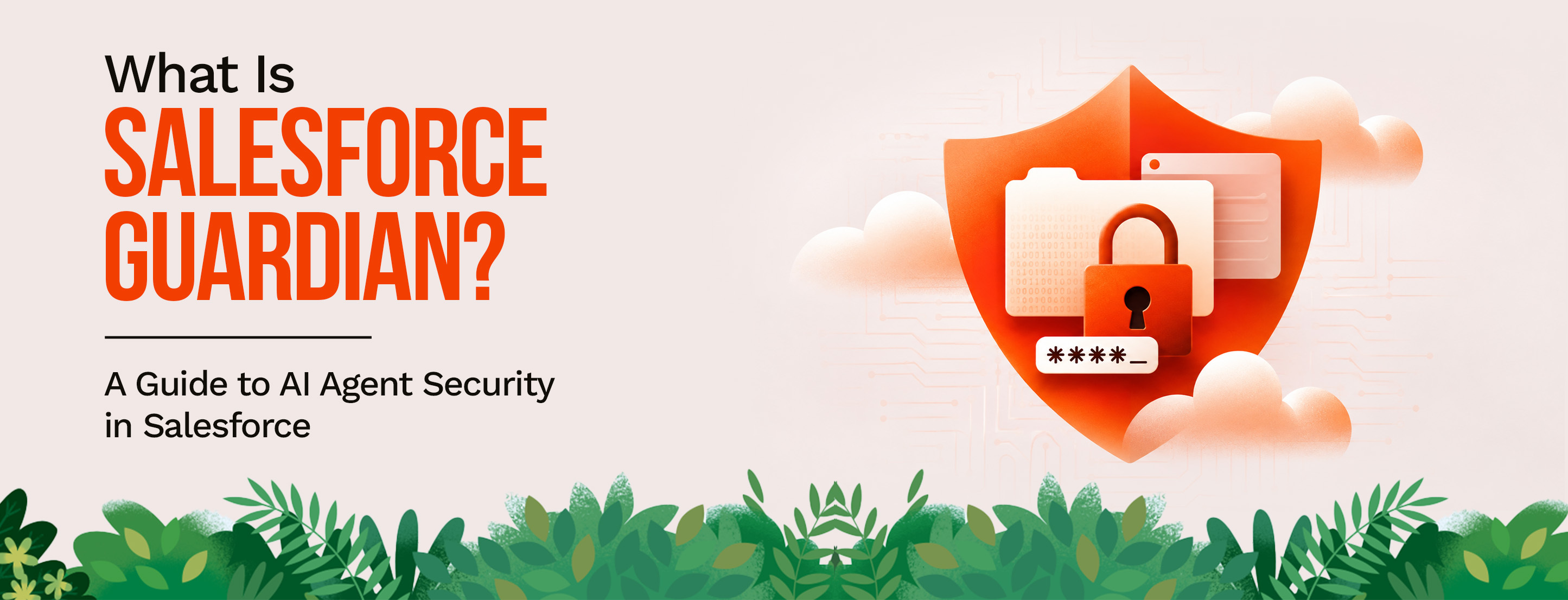
That is where Salesforce Guardian comes in.
Guardian brings Salesforce’s existing security, privacy, compliance, and data protection capabilities together while extending that security model for AI agents. At Dreamforce 2026, Salesforce put particular focus on two areas: agent identity and data security.
Here is what that actually means.
Salesforce Guardian is Salesforce’s suite of security, privacy, compliance, and data resilience products for protecting the Salesforce environment, including data and the AI agents that use it.
Guardian is not an entirely new security product built from scratch for Agentforce.
Salesforce already uses Guardian as an umbrella for advanced security and privacy offerings such as Salesforce Shield, Security Center, Privacy Center, Data Mask & Seed, Backup & Recover, and Archive.
What changed at Dreamforce 2026 was the focus.
As companies start deploying more autonomous agents, Salesforce is extending Guardian beyond traditional user and data security into areas such as agent identity, risky agent behavior, data classification, and data lifecycle protection.
A traditional Salesforce user signs in, has a defined role, receives specific permissions, and performs actions within those boundaries.
Agents change the equation. An AI agent might need to:
That access makes agents useful. At the same time, it also gives security teams some new questions to answer:
Salesforce Guardian is being positioned around those questions.
At Dreamforce 2026, Salesforce placed Guardian inside a broader enterprise AI architecture.
One example flow looked roughly like this:
Informatica → Data 360 → Tableau → Salesforce Guardian → Agent Fabric
Each part has a different job:
Guardian is therefore not the agent itself. It sits around the environment where agents operate in.
At Dreamforce, Salesforce narrowed its newer Guardian capabilities down to two major areas.
As agents become more autonomous, simply letting them operate with a human user’s permissions can create unnecessary access.
Agent identity gives businesses a way to think about agents as identities of their own. That makes it easier to control what an agent should be able to access or do instead of automatically giving it everything available to the person who started the task.
Salesforce Guardian can evaluate these agent identities, and identify agents considered risky based on their permissions and the actions they were taking.
For security teams, that brings a useful layer of visibility: not just who the agent is, but whether its behavior deserves attention.
Agents are only as useful as the context they can access. But that context may include customer information, financial data, intellectual property, employee information, business rules, and other sensitive records.
Guardian’s data security focus includes:
This matters even more as Data 360 makes more enterprise context available to AI.
More context can make an agent better at its job. It also makes knowing what that agent is allowed to see much more important.
Salesforce also connected Guardian with its wider Zero Data Retention approach.
The idea is that enterprise data accessed via supported Salesforce AI experiences should remain the customer’s data rather than being retained by external models to train those models.
For organizations putting confidential business context in front of AI, that becomes an important part of the overall security model.
Guardian is broader than the new agent-focused capabilities shown at Dreamforce.
Salesforce uses the Guardian name across several of its security, privacy, compliance, and resilience products and services.
Salesforce Shield is the core advanced security suite. It includes:
Together, these capabilities help businesses encrypt sensitive information, monitor activity, maintain audit history, identify sensitive data, and create policies around risky behavior.
For Agentforce environments, that existing security foundation becomes even more important because agents are interacting with the same Salesforce data.
Security Center gives teams a centralized view of their Salesforce security posture. Instead of checking every org individually, security teams can monitor security health, spot misconfigurations, review risks, and investigate potential issues from across the environment at one place.
As agent usage grows, that centralized visibility becomes useful for understanding security beyond individual users and records.
Privacy Center focuses on how personal data is collected, retained, managed, and deleted. It can help businesses manage:
If an AI agent can use customer data, privacy controls still apply. Adding an agent does not make consent and retention requirements disappear.
Development teams need realistic data to build and test Salesforce solutions. They usually do not need actual customer PII to do it.
Data Mask & Seed lets organizations anonymize or mask sensitive production information before it reaches test and sandbox environments. That allows teams to build and test AI-enabled workflows without unnecessarily exposing real customer data.
AI agents can take actions at much greater speed and scale than an individual user. That makes resilience just as important as prevention.
Backup & Recover provides automated backups, alerts for data loss or corruption, and restoration capabilities if something goes wrong.
Not every record needs to stay in an active Salesforce environment forever. Archive helps businesses move historical or less frequently used data according to retention policies while keeping it accessible when required.
Reducing unnecessary live data can also reduce the amount of information potentially exposed to users, integrations, and agents.
Guardian and Agent Fabric were shown together at Dreamforce, which makes them easy to confuse. They solve different problems.
The easiest way to remember the difference is:
Agent Fabric helps you manage your agents. Guardian helps you secure them.
And in larger Agentforce environments, businesses will likely need both sides of that equation.
Agentforce is where businesses build and deploy AI agents.
Those agents can then work with Salesforce data, workflows, actions, APIs, and external systems. Guardian provides the security layer around that activity.
Example:
Consider a service agent that needs access to customer records, payment history, case data, and internal knowledge.
The agent needs enough access to solve the problem. But it probably should not automatically receive unrestricted access to every customer record or sensitive field simply because an employee interacting with it has broader permissions.
That is the kind of gap agent identity and stronger data classification can help address.
So while Agentforce gives agents their capabilities, Salesforce Guardian helps define and protect the boundaries around those capabilities.
Guardian becomes especially relevant once Agentforce moves beyond a small pilot, so who really should pay attention:
The common theme is simple: adding an agent does not remove your existing security responsibilities. It adds another identity that needs to be governed.
Yes and no.
The Guardian name and security product family already existed before Dreamforce 2026.
Salesforce already grouped advanced products including Shield, Security Center, Privacy Center, Data Mask & Seed, Backup & Recover, and Archive under its Guardian security framework.
What Dreamforce added was a clearer agentic security story.
Salesforce described Guardian as an evolution of Shield and Trusted Services and emphasized new innovation around:
So it is more accurate to say Salesforce is expanding Guardian for the agentic enterprise than to say Salesforce launched an entirely new security product at Dreamforce.
AI agents getting smarter is only half the story. They are also getting access to more data, more systems, and more actions.
That makes security much harder to bolt on later.
Salesforce Guardian brings together the security, privacy, and resilience capabilities businesses already use in Salesforce while extending that protection toward agent identity and AI data access.
For teams expanding Agentforce, the next step is not simply adding more agents. It is making sure every agent has the right access, the right data, and the right boundaries.
At MIDCAI, our Agentforce consulting and implementation services help businesses design agents around the right Salesforce data, permissions, integrations, and governance from the start.
Before your agents get more access, make sure you know exactly what they can do with it.

5+ years of experience in content strategy, marketing, and technical communication. At MIDCAI, I focus on turning ideas around Salesforce, data, and AI into clear, actionable insights that help enterprises attract the right audience and drive real adoption.
Got questions? We’ve got answers. Explore common queries to understand how we work and what to expect.
Salesforce Guardian is Salesforce’s suite of security, privacy, compliance, and data resilience products for protecting the Salesforce environment, including the data and the AI agents that use it. It covers products such as Shield, Security Center, Privacy Center, Data Mask & Seed, Backup & Recover, and Archive.
No. Guardian secures agents and enterprise data, and is aimed at security teams working on identity, risk, access, and data classification. MuleSoft Agent Fabric helps IT and platform teams discover, manage, govern, and monitor agents. In short, Agent Fabric manages your agents and Guardian secures them.
Not entirely. The Guardian name and its security product family existed before Dreamforce 2026. What Dreamforce added was a clearer agentic security story, with new focus on agent identity, risky agent behavior, data classification, and data lifecycle protection.
Agent identity lets businesses treat an AI agent as an identity of its own instead of having it inherit everything the person who started the task can access. Guardian can evaluate those agent identities and flag agents considered risky based on their permissions and the actions they take.
Get in touch with us for any enquiries and questions
Define your goals and identify areas where technology can add value to your business
We are looking for passionate people to join us on our mission.
where your skills fuel innovation and your growth powers ours
.jpg)