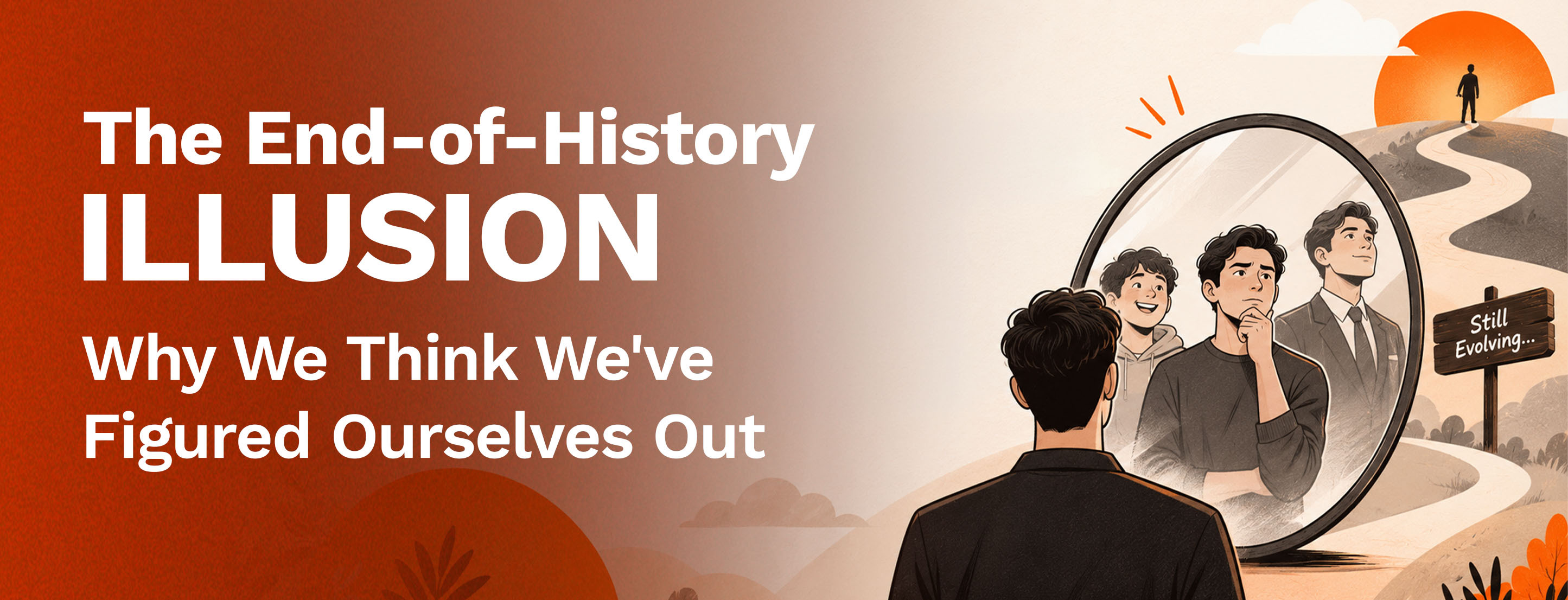


Imagine asking yourself two questions:
Chances are, you'll have a long list of ways in which your past self differs from who you are today. Your priorities have changed, your relationships have evolved, your beliefs may have shifted, and things that once seemed important may no longer matter.
But when you imagine your future self, you might picture someone who is more or less like the person you are today.
You acknowledge that the person you were ten years ago was different. Yet you unconsciously assume that the person you will be ten years from now will be quite similar to who you are today.
This contradiction is known as the End-of-History Illusion.
And it reveals something fascinating about human psychology: we are surprisingly good at recognising our personal evolution, but not so good at anticipating it.
Introduced by psychologists Jordi Quoidbach, Daniel T. Gilbert and Timothy D. Wilson in their 2013 research paper, The End of History Illusion, this concept describes our tendency to acknowledge how much we have changed in the past while underestimating how much we are likely to change in the future.
In simple terms, we see our past selves as unfinished projects, but somehow consider our present selves to be the final product.
The researchers conducted studies involving more than 19,000 participants and examined changes in personality, personal values and preferences. They found a consistent pattern: people reported significant changes over the previous decade but expected considerably less change in the coming decade.
Interestingly, this tendency appeared across different age groups.
Think about it. A 20-year-old might believe they have finally understood what they want from life. A 40-year-old might feel they have figured out their priorities. Even a 60-year-old might underestimate how much their perspectives could still evolve.
It is almost as if, at every stage of life, we believe we have reached a point of relative permanence.
But why?
One of the simplest explanations is that we become so familiar with our present identity that we mistake it for something permanent.
We know what makes us happy today, what irritates us, what we value and what we want to achieve. These preferences become such a natural part of our everyday existence that imagining them changing feels almost impossible.
Consider someone who has always prioritised professional success. They might find it difficult to imagine a future where personal freedom, family time or a slower pace of life becomes more important.
Not because such a transformation is impossible, but because their current identity makes it difficult to picture.
We often confuse familiarity with permanence.
Think about the experiences that have shaped you.
Perhaps it was a difficult relationship, a professional setback, moving to a new city, losing someone you loved or meeting someone who challenged everything you believed in.
Did you know beforehand how much these experiences would change you?
Probably not.
Yet, when imagining our future, we tend to assume that the person we are today will continue to respond to life in much the same way.
We forget that there are people we haven't met, places we haven't visited, challenges we haven't encountered and experiences we cannot even imagine yet.
The future is not simply an extension of our present circumstances. It is also a collection of experiences that may fundamentally change how we see ourselves and the world.
When we look at our past, we can connect the dots.
We understand why certain things mattered, what changed our perspective and how particular experiences influenced our decisions.
But the future doesn't offer us that clarity.
We cannot predict which conversation will change our thinking, which disappointment will redirect our ambitions or which seemingly insignificant experience will become a defining moment in our lives.
The past is a story we can interpret. The future is a story we haven't experienced yet.
And perhaps that is why we find it easier to recognise change retrospectively than anticipate it prospectively.
There is a certain comfort in believing that we know who we are.
Having a stable sense of identity helps us navigate life. It gives us a sense of direction and makes decision-making easier.
We tell ourselves:
And while these statements may be perfectly true today, we sometimes forget to leave room for the possibility that they might not remain true forever.
Perhaps we don't necessarily want to believe that we are still figuring things out. There is comfort in feeling that we have finally arrived.
The interesting thing about the End-of-History Illusion is that it isn't limited to our thoughts about identity. It quietly influences the decisions we make every day.
Our careers: At one point, we might believe that a particular designation, salary or professional achievement is the ultimate definition of success. Years later, we may realise that what we really wanted was flexibility, creative freedom or simply a healthier relationship with work.
Our relationships: The way we understand love, friendship and companionship can change considerably as we grow. What we once considered essential in a relationship might become less important, while qualities we previously overlooked may become non-negotiable.
Our ambitions: Remember the things you desperately wanted five or ten years ago? Some of them may have become irrelevant. Others might still matter, but perhaps for entirely different reasons.
Our definition of happiness: At different stages of life, happiness can mean different things. It might once have meant recognition, financial success or adventure. Today, it might mean peace of mind, meaningful relationships or having control over your time.
The interesting part is that we rarely anticipate these transformations accurately.
We make decisions based on who we are today, often forgetting that the person who will live with those decisions might think very differently.
This brings us to perhaps the most practical implication of the illusion.
We often make long-term commitments based on our present preferences, assuming that our future selves will continue to feel the same way.
We subscribe to things we might eventually stop using, pursue goals that may no longer excite us and sometimes make rigid plans around interests that are still evolving.
Of course, planning for the future is important. But there is a difference between having a direction and assuming that your destination will never change.
Perhaps the better approach is to make plans while leaving enough room for the possibility that we might outgrow them.
We should be able to change careers without feeling that our earlier choices were mistakes, reconsider our ambitions without feeling inconsistent and outgrow certain relationships or beliefs without feeling guilty about who we once were.
Growth doesn't always mean becoming a completely different person. Sometimes, it simply means discovering that there is more to us than we previously understood.
This is where the concept becomes more philosophical.
We often speak about self-discovery as if there is a final version of ourselves waiting somewhere in the future.
We say things like, "I've finally figured out what I want," or "I now know exactly who I am."
But what if self-discovery isn't a destination at all?
What if it is a continuous process of questioning, unlearning, experiencing and evolving?
The person you were ten years ago wasn't necessarily wrong. They were simply making sense of life with the experiences, knowledge and understanding available to them at that point.
Similarly, the person you will become ten years from now may look back at your present self with the same sense of surprise.
Perhaps maturity isn't about finally having all the answers. Perhaps it is about becoming comfortable with the possibility that some of your answers will change.
And maybe that's not a sign of inconsistency. Maybe that's simply what being human looks like.
The End-of-History Illusion reminds us of something we often overlook: we are not finished products.
The things we value today may evolve. Our ambitions may take a different direction. Our understanding of happiness may become more nuanced. Even the things we once considered central to our identity may eventually become just another chapter in our story.
And that's okay.
We don't have to hold on to every version of ourselves just because we once identified with it. We don't have to fulfil every ambition we once had or defend every belief we once held.
We are allowed to change our minds. We are allowed to outgrow our old dreams. We are allowed to become people our younger selves could never have imagined.
Perhaps the biggest mistake isn't that we don't know who we will become.
It is that we assume we already know.
Because the person you are today is not the final version of you. It is simply the version you happen to be right now.

Currently working as a QA Intern at MIDCAI, I’m learning the ropes of software testing, understanding project workflows, and growing through hands-on experience in a fast-paced environment. Beyond tech, I’m deeply interested in writing, workplace dynamics, and exploring the realities of office culture through observations and conversations.
Get in touch with us for any enquiries and questions
Define your goals and identify areas where technology can add value to your business
We are looking for passionate people to join us on our mission.
where your skills fuel innovation and your growth powers ours