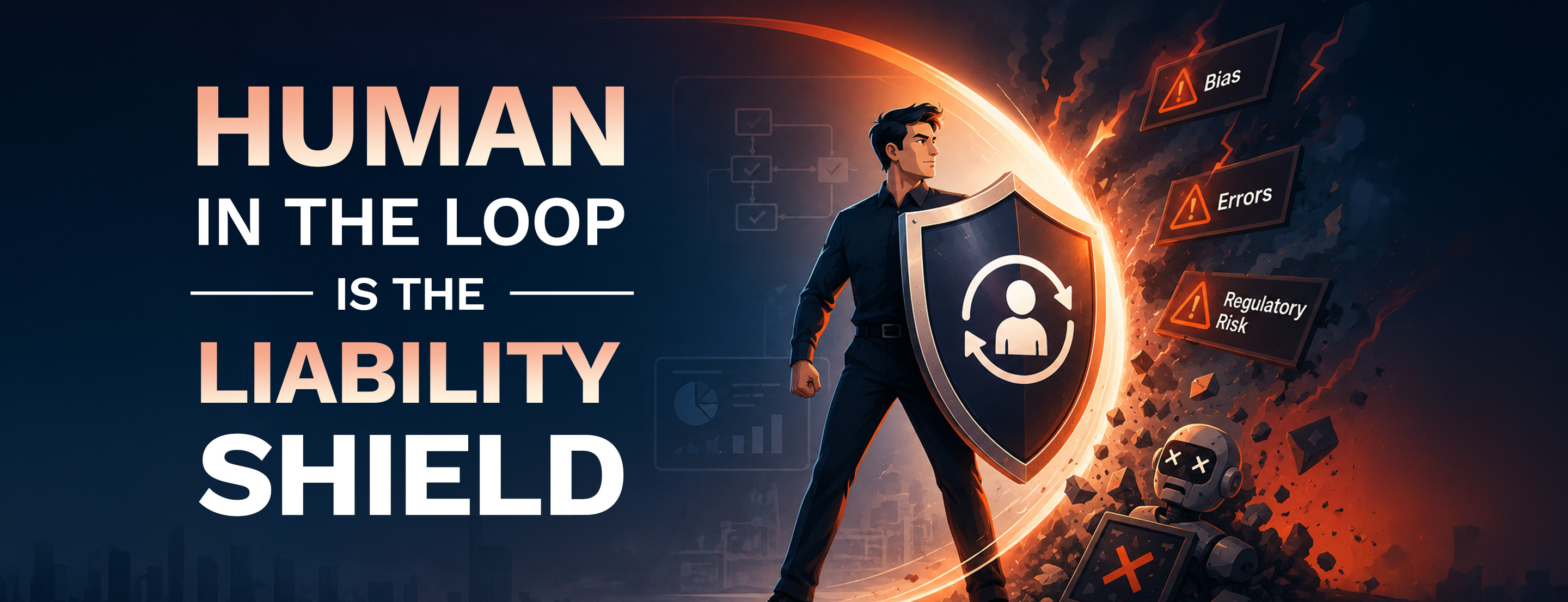

I've put the phrase "human in the loop" into proposals. More than once.
It works every time. You say it and the room settles. Legal stops asking. The client stops asking. The board moves on. Everyone agrees the thing is safe now, because a person is watching it.
I believed that for a long time. Then I started paying attention to what actually happens after the room empties.
There are three completely different arrangements out there. Most people call all of them the same thing.
The first one, Human in the Loop. The person can actually stop it. The worker sits there and waits for them. If they don't act, nothing happens.
The second one is Human on the Loop. The person watches it go by. They could step in. They rarely do, because stepping in means overruling something that already looks finished.
The third one has no name, so I'll give it one. The Human in the Record.
The work goes out either way. Their name is attached to it. If they'd done nothing at all that day, the outcome would have been exactly the same. They aren't reviewing it. They're on it.
Most of what gets sold as the first thing turns out to be the third thing. And I don't think many of us set out to do that.
So let's look at this from three seats: the boardroom, the reviewer's desk, and the client's side of the table.
I'll speak for myself here, because I've been this person.
1. We didn't put a reviewer in because we assessed the risk:
We put one in because we couldn't get the project approved without it. Someone senior asked what happens when something goes wrong. We said a person checks everything. The room settled. The project moved.
2. Then look at what we actually handed that person:
A step in a workflow. A deadline. A throughput number they get measured on. No authority to stop a release without becoming the reason it slipped. No upside for catching something, and full exposure if they missed it.
3. We didn't build oversight -we built a name for the incident report:
We knew, at some level, that the reviewer couldn't really say no. The timeline didn't allow for it. The incentives didn't allow for it. We built a process that needed to run, and we put a person's name on it so that if it broke, the question of who approved it would have an answer.
That's not a safety mechanism. That's a liability transfer. And we dressed it up in the language of human oversight because that's what got the project signed.
The cost this creates for the business itself: it's not just a leadership blind spot — it's exposure sitting on the balance sheet. When something does go wrong, "a human reviewed it" doesn't hold up the way leadership assumed it would in an audit, a lawsuit, or a client walking. The org finds out, at the worst possible moment, that the safeguard it was relying on was never load-bearing.
If you're the one reviewing, you already know what I'm about to say.
1. The queue moves faster than any real check is possible:
The work looks fine. It usually is fine. Checking it properly would take almost as long as doing it yourself, which is the entire thing this was supposed to fix. So you scan. You develop an instinct for what looks right. You approve at a pace that fits the deadline, because the deadline is the thing you're actually being measured on.
2. Catching something gets you nothing - missing something costs you everything:
Nobody messages you when you catch a problem. There is no line in your appraisal for the disaster that didn't occur. But when you miss one, your name is the first thing anyone looks for. The timestamp is right there. The approval is right there.
3. You were never the last line of defence - you were the last line of documentation:
The process was designed to run whether you acted or not. Your judgement was never really the variable. Your signature was. The design put you there to absorb accountability that should have stayed at the top, and called it oversight to make it sound like trust.
Most people sitting where you are believe the problem is them. Their attention. Their speed. Their diligence. It isn't.
The client isn't buying the review. They're buying the sentence.
1. "A person reviews everything before it goes live" is load-bearing language:
That sentence is what gets past the procurement checklist. Take it out of the proposal and the conversation changes immediately. But it doesn't specify which of the three arrangements you're getting. It doesn't say whether the reviewer can stop it or just sign it.
2. Most vendors never volunteer what the review actually looks like:
I've never had a client ask which arrangement they were getting. And I will be honest: for a long time I never volunteered the answer. Because the answer, in most cases, is that you've bought a name on a document. A real person, a real timestamp, and no real authority to change the outcome.
3. One question changes everything before you sign:
Ask what happens if the reviewer pushes back and refuses to approve — not in theory, but in practice. Who does it escalate to, on what timeline, and has that path ever actually been used?
If nobody can answer that clearly, you haven't bought oversight. You've bought the appearance of it. And the difference only becomes visible when something goes wrong.
Nobody here is the villain. I've been most of these people.
Everyone did something sensible. The leader got the project approved. The reviewer worked to the time they had. The client believed the line in the proposal. And what came out the other side was something that runs whether anyone is watching or not, with a person's name on it.
Twenty years in, that's the failure I trust least. Not the obviously bad call. The sensible ones, stacked, until nobody can see the shape of what they've built.
So here's the only question that matters this week.
If the person reviewing your work simply didn't turn up tomorrow, would anything stop?
Most people have never asked. It takes a minute to find out.

With 20 years across consulting, technology, and leadership, I’ve seen how great work is shaped by both systems and people. Building MIDCAI is my next chapter, where experience meets clarity, and AI, data, CRM, and MarTech come together with a deeply human approach.
Get in touch with us for any enquiries and questions
Define your goals and identify areas where technology can add value to your business
We are looking for passionate people to join us on our mission.
where your skills fuel innovation and your growth powers ours