

Environmental, Social, and Governance (ESG) reporting is no longer a static annual exercise. It is a continuous data-driven process that demands visibility, accuracy, and audit readiness. Organizations today are expected to track carbon emissions, workforce diversity, ethical governance practices, and supply chain transparency, all in measurable, reportable formats.
The challenge? ESG data rarely lives in one system.
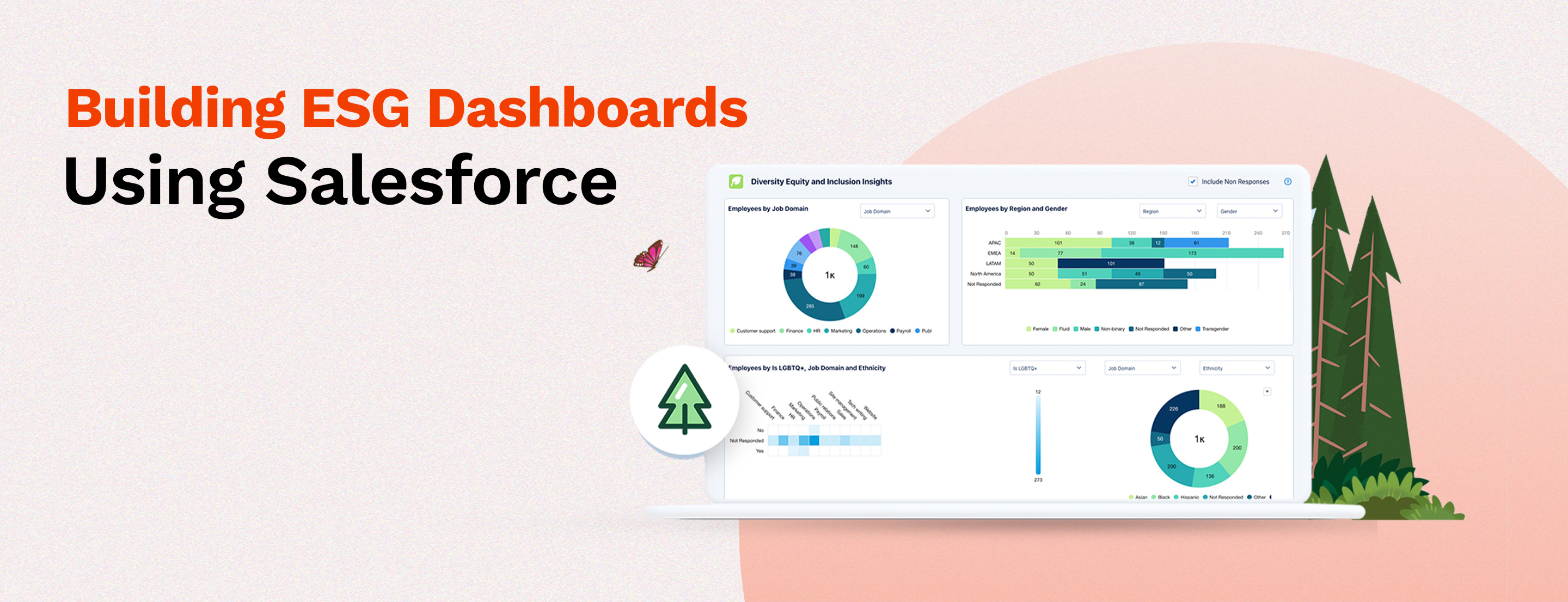
This is where Salesforce becomes strategically powerful. When architectured correctly, Salesforce can act as a unified ESG data layer consolidating operational, financial, supplier, and HR data into dynamic, executive-ready dashboards.
This article explores how to technically design and implement ESG dashboards using Salesforce from data modeling to visualization.
Before building dashboards, organizations must structure their ESG data model.
Environmental
Social
Governance
In Salesforce, this data can be structured using:
For carbon-specific tracking, organizations can leverage Net Zero Cloud, which provides pre-built data models and emissions calculation frameworks.
ESG dashboards are only as accurate as their source data.
Common ESG Data Sources:
Salesforce supports integration through:
Data harmonization is critical. Units of measurement, reporting frequencies, and data definitions must be standardized before visualization. Without harmonization, dashboards become misleading.
Selecting the Appropriate Analytics Layer
Salesforce offers multiple analytics capabilities depending on reporting complexity.
Standard Reports & Dashboards
Ideal for:
These dashboards support near real-time visibility and are effective for sustainability managers and operational teams.
Advanced Analytics with CRM Analytics
For executive-level ESG intelligence, organizations deploy CRM Analytics (formerly Tableau CRM). This enables:
For example, sustainability leaders can simulate carbon reduction trajectories against publicly stated targets, identifying performance gaps early.
Advanced analytics transforms ESG dashboards from descriptive reporting into predictive management tools.
Effective ESG dashboards are structured around strategic decisions and not data volume.
Core Executive Dashboard Sections
Environmental Performance
Social Impact Metrics
Governance & Risk
Visualization Best Practices
An executive ESG dashboard should answer three questions:
Manual reporting introduces errors and delays.
Salesforce automation tools including Flow, Scheduled Jobs, Apex Triggers, and Platform Events enable:
Automation ensures dashboards reflect current performance, not historical approximations.
When ESG metrics trigger operational workflows, sustainability becomes embedded in business processes.
ESG dashboards must align with recognized reporting standards to ensure credibility.
Common frameworks include:
By mapping Salesforce data fields directly to framework indicators, organizations can:
Framework alignment transforms dashboards into compliance-ready systems.
Governance, Security, and Audit Readiness
Because ESG data often intersects with HR and compliance information, governance controls are essential.
Best practices include:
Each reported emission value or diversity metric should be traceable to its source system.
Audit readiness builds stakeholder trust.
With structured ESG datasets in place, Salesforce AI capabilities can identify:
AI shifts ESG dashboards from static summaries to intelligent monitoring platforms.
This is where ESG transitions from reporting obligation to strategic advantage.
Even well-intentioned ESG dashboard initiatives fail due to:
ESG dashboards must be built as enterprise programs not isolated IT projects.
Building ESG dashboards using Salesforce is not merely about visualizing sustainability metrics. It is about embedding ESG accountability into core operational systems.
When emissions data, workforce metrics, compliance tracking, and executive reporting coexist within a unified platform, sustainability becomes measurable, actionable, and strategically managed.
In today’s regulatory and investor landscape, ESG transparency is no longer optional.
Organizations that design structured, automated, and intelligent ESG dashboards today will lead tomorrow’s sustainable economy not just in reporting performance, but in driving it.

Working as Manager – People and Admin in a dynamic environment at MIDCAI, I’m passionate about creating people-first processes, building purposeful teams, and driving operational efficiency. I thrive on meaningful collaboration and continuous learning. Whether it’s supporting team growth, creating systems that empower people, or adapting to a rapidly evolving tech landscape, I bring heart and hustle to every challenge.
Get in touch with us for any enquiries and questions
Define your goals and identify areas where technology can add value to your business
We are looking for passionate people to join us on our mission.
where your skills fuel innovation and your growth powers ours